During the 1980s, crop circles evolved from a localized British curiosity into a massive global cultural phenomenon, capturing worldwide media attention and sparking fierce debates about extraterrestrial life. What began as simple circular depressions in the late 1970s rapidly exploded in both geometric complexity and frequency throughout the decade.
The vast majority of 1980s crop circles appeared overnight in southern England, specifically within agricultural fields across Wiltshire and Hampshire. Many of these formations emerged near ancient, mystical landmarks like Stonehenge and Avebury, which heavily fueled fringe theories about their origins.
As the decade progressed, the visual nature of the crop formations underwent a massive transformation:
Early 1980s: Formations mostly consisted of simple, isolated circles or basic "saucer nests" measuring a few dozen feet in diameter. The term "crop circle" was officially coined in the early 1980s by electrical engineer Colin Andrews. Andrews and other enthusiasts established the field of "cereology" to document, photograph, and scientifically analyze the strange new formations.
Mid-to-Late 1980s: The designs grew exponentially more sophisticated, introducing multiple concentric rings, parallel straight lines, intricate spirals, and highly symmetrical geometric layouts stretching hundreds of feet across.
Prominent 1980s Theories
Extraterrestrial/UFOs: The dominant pop-culture belief was that the circles were landing tracks or coded pictographic messages left by alien spacecraft.
Earth Energies: Ley lines, Earth meridians, and localized magnetic forces intersecting near ancient stone circles were blamed.
Weather Anomalies: Some researchers tried to validate the phenomenon through obscure natural causes, such as freak mini-tornadoes, stationary wind vortices, or ionized plasma balls.
Animal Activity: Outlandish fringe explanations even suggested the circles were caused by hyperactive, mating hedgehogs running in circles.
Inspired by a 1966 UFO report from Australia, the duo used nothing more than wooden planks, ropes, measuring tapes, and wire attached to baseball caps to site straight lines and stamp down the crops under the cover of darkness. As media attention and "expert" speculation grew during the 1980s, Bower and Chorley intentionally designed increasingly complex geometric shapes just to confound researchers and see how far they could push the global prank.

Crop Circles and A.I.
There were a record number of crop circles in the year 1990, marking a massive turning point when the phenomenon exploded into global pop culture. During this year, the designs evolved from simple, basic shapes into massive, highly complex geometric patterns known as "pictograms".
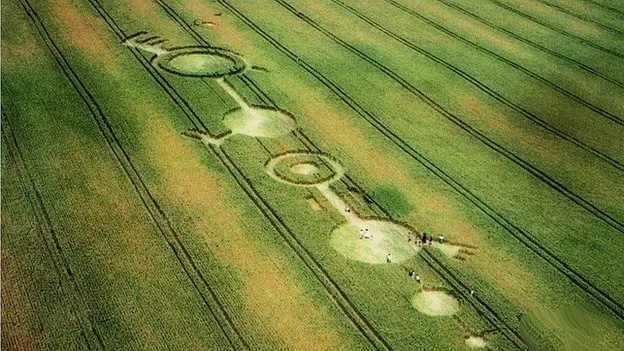
The most famous crop circle of 1990 - and arguably of all time - was the Eastfield Pictogram, discovered in July 1990 near Alton Barnes in Wiltshire, England. It was a massive, 600-foot-long formation consisting of multiple circles, straight lines, and claw-like shapes. The design became so famous that the legendary rock band Led Zeppelin used a photograph of it for the cover of their Remasters album box set released in October 1990.
The sheer complexity of the 1990 formations triggered intense media coverage and scientific debate.
Researchers and "cereologists" (crop circle investigators) fiercely debated whether they were caused by extraterrestrial visitors, mystical Earth energies, or a rare meteorological phenomenon called "plasma vortices".
In the summer of 1990, high-profile copycats and pranksters also began actively tricking researchers. For example, the BBC Archive details a 1990 prank where perpetrators set up fake orange lights in the sky and left a Ouija board inside a poorly trampled field to mock over-eager scientists.
While 1990 was the peak of "crop circle fever," the mystery was largely solved just one year later. In September 1991, two English co-conspirators named Doug Bower and Dave Chorley confessed to creating over 200 crop circles across the English countryside since 1978 using planks of wood, ropes, and baseball caps with wire sights to walk in straight lines. Their confession inspired countless copycat artists, continuing the landscape art tradition throughout the decade.
Crop Circles and A.I.