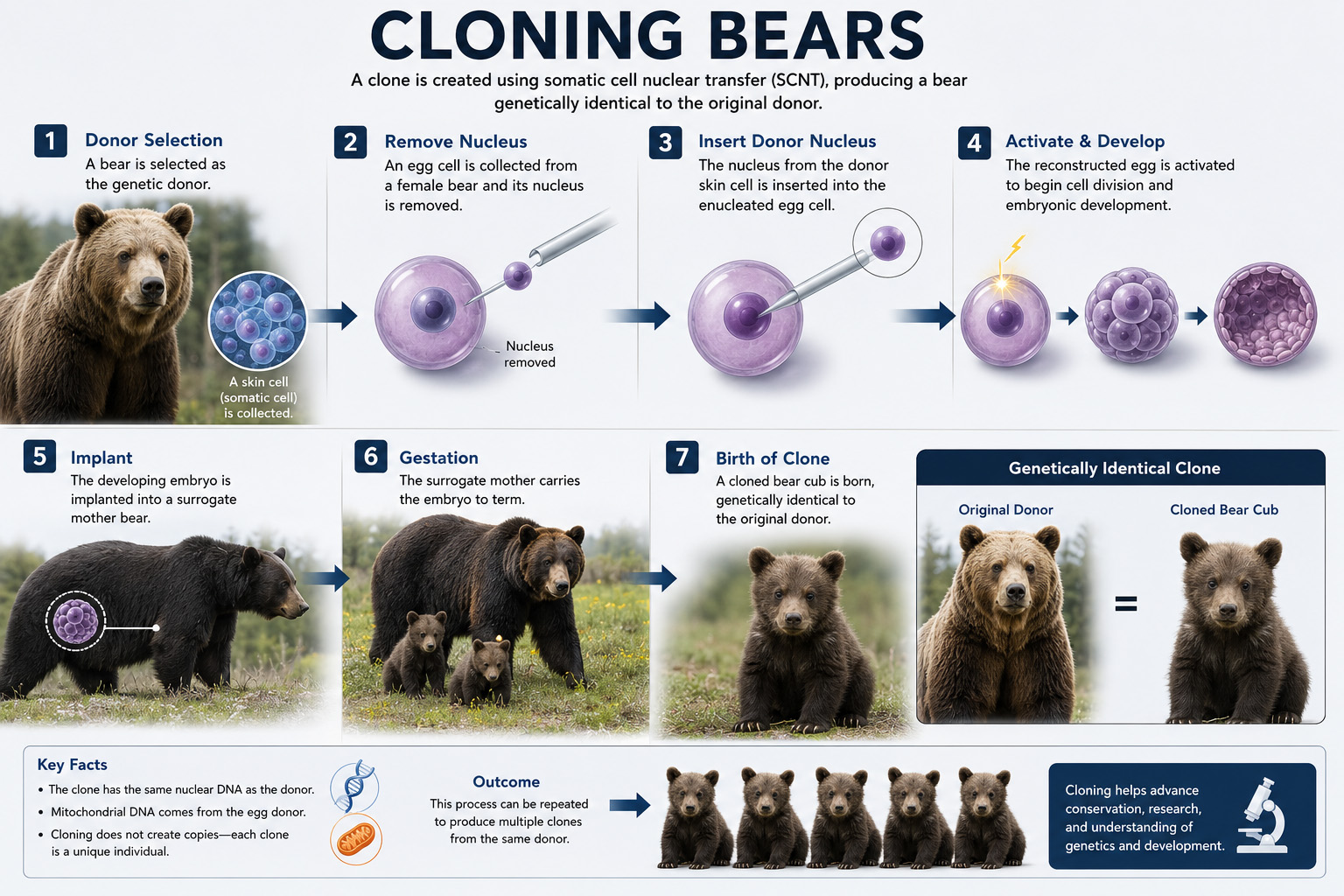
Bear cloning bridges the gap between preserving vulnerable living populations and utilizing advanced genetic engineering for the "de-extinction" of ancient species.
While true reproductive cloning via Somatic Cell Nuclear Transfer (SCNT) has successfully revived animals like the Arctic wolf and the black-footed ferret, a live-born cloned bear has not yet been documented. Instead, scientific momentum focuses on extracting ancient DNA, mapping multi-species hybridization, and engineering the cellular traits of both extinct and endangered bears.
The most widely discussed intersection of bears and genetic cloning centers on the giant short-faced bear (Arctodus simus), an Ice Age megafauna that stood up to 14 feet tall.
Because DNA degrades substantially over thousands of years, scientists cannot perfectly copy or synthesize a full ancient genome. Instead, geneticists plan to sequence fragments of ancient DNA found in fossilized bones and teeth.
Companies like Colossal Biosciences leverage CRISPR editing to identify genes controlling prehistoric traits - such as massive skeletal structures or distinct metabolic systems - and insert them into the cells of modern grizzly bears.
Any engineered embryo would require a modern surrogate mother. Because dogs, wolves, and bears share high genomic sequence identity, researchers have mapped the boundaries of interspecies nuclear transfers to see if modern ursines could carry a proxy embryo to term.
Panda cloning 'faces last hurdle' November 2002 - BBC
China has cleared two major hurdles in its quest to clone the highly endangered giant panda and just one problem remains to be surmounted, the scientist leading the project says. Chen Dayuan said researchers had worked out how to create a panda embryo using an egg cell from another species and implant the embryo in the uterus of a surrogate mother, also of a different species.
Panda clone could save species BBC - June 22, 1999
Chinese scientists say they have successfully produced an embryo clone of a giant panda, and are hoping that it will now develop to maturity. They are hailing it as a possible breakthrough in their efforts to save one of the world's most endangered species. Only about 1,000 pandas live in the wild, with another 100 in zoos. They are notoriously reluctant to reproduce, and experts have warned that the animal could be extinct within 25 years. The state-run Xinhua news agency said researchers from the Chinese Academy of Sciences introduced genetic material from a dead female panda into the egg cells of a white rabbit. The resulting embryo was nurtured over 10 months and scientists are now trying to implant it in a host animal's uterus.