
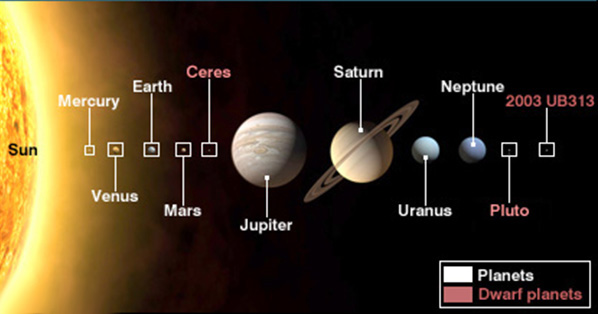
Ceres (minor-planet designation: 1 Ceres) is a dwarf planet in the main asteroid belt between the orbits of Mars and Jupiter. It was the first known asteroid, discovered on 1 January 1801 by Giuseppe Piazzi at Palermo Astronomical Observatory in Sicily, and announced as a new planet. Ceres was later classified as an asteroid and more recently as a dwarf planet, the only one not beyond the orbit of Neptune and the largest that does not have a moon.
Ceres's diameter is about a quarter that of the Moon. Its small size means that even at its brightest it is too dim to be seen by the naked eye, except under extremely dark skies. Its apparent magnitude ranges from 6.7 to 9.3, peaking at opposition (when it is closest to Earth) once every 15- to 16-month synodic period. As a result, its surface features are barely visible even with the most powerful telescopes, and little was known about it until the robotic NASA spacecraft Dawn approached Ceres for its orbital mission in 2015.
Dawn found Ceres's surface to be a mixture of water, ice, and hydrated minerals such as carbonates and clay. Gravity data suggest Ceres to be partially differentiated into a muddy (ice-rock) mantle/core and a less dense, but stronger crust that is at most thirty percent ice by volume. Although Ceres likely lacks an internal ocean of liquid water, brines still flow through the outer mantle and reach the surface, allowing cryovolcanoes such as Ahuna Mons to form roughly every fifty million years. This makes Ceres the closest known cryo-volcanically active body to the Sun. Ceres has an extremely tenuous and transient atmosphere of water vapor, vented from localized sources on its surface. Read more ...
There appear to be extraterrestrial pyramid shaped objects in space. Whether they are natural formations or something created by a higher intelligence is yet to be known.
Ceres: Dawn's latest orbit reveals dramatic new views of Occator crater PhysOrg - July 2, 2018
NASA's Dawn spacecraft reached its lowest-ever and final orbit around dwarf planet Ceres on June 6 and has been returning thousands of stunning images and other data. The flight team maneuvered the spacecraft into an orbit that dives 22 miles (35 kilometers) above the surface of Ceres and viewed Occator Crater, site of the famous bright deposits, and other intriguing regions. In more than three years of orbiting Ceres, Dawn's lowest altitude before this month was 240 miles (385 kilometers), so the data from this current orbit bring the dwarf planet into much sharper focus. These low orbits have revealed unprecedented details of the relationships between bright and dark materials in the region of Vinalia Faculae. Dawn's visible and infrared mapping spectrometer had previously found the bright deposits to be made of sodium carbonate, a material commonly found in evaporite deposits on Earth. Last week Dawn fired its ion engine, possibly for the final time, to fly nearer Cerealia Facula, the large deposit of sodium carbonate in the center of Occator Crater.
Dawn is barnstorming Ceres and seeing wonders - shiny mineral deposits Syfy.com - July 6, 2018
Occator is about 92 km wide, and two bright spots in it were seen even as Dawn approached Ceres in 2015, and were maddeningly vague until the spacecraft achieved orbit. Then the spots were resolved into many smaller ones, associated with cracks in the crater floor and on its central mound. Could they be ice? It turns out it was even better: They were mineral deposits! Ceres has an icy mantle beneath its surface, and deep cracks in the surface allow the ice to seep up. When it gets hit by sunlight it turns directly into a gas. And while this is water ice, it's not fresh water: It's briny, with mineral dissolved in it. When the ice sublimates it leaves those minerals behind, depositing them on the surface. Ceres is very dark, and the minerals much brighter, so they look white in the images.
Geology of Ceres illuminates origin of organics Science Daily - February 16, 2017
NASA's Dawn spacecraft recently detected organic-rich areas on Ceres. Scientists evaluated the geology of the regions to conclude that the organics are most likely native to the dwarf planet. Data from the spacecraft suggest that the interior of Ceres is the source of these organic materials, as opposed to arriving via impacting asteroids or comets, according to a new article.
Water Ice Found On Dwarf Planet Ceres, Hidden in Permanent Shadow Live Science - December 16, 2016
Just like the moon and Mercury, the largest asteroid in Earth's solar system, Ceres, has cold pockets of perpetual darkness on its surface where researchers have now detected ice, a new study finds. It remains a mystery, however, why only small amounts of ice were detected in these shadowy crater floors, the authors of the new research say. With a diameter of about 585 miles (940 kilometers), Ceres is referred to as both an asteroid and a dwarf planet. It is the dwarf planet closest to Earth and the largest member of the solar system's main asteroid belt, located between Mars and Jupiter. Water is not entirely uncommon on Ceres - previous observations revealed plumes of water vapor erupting from Ceres, exposed water ice has been seen at mid-latitudes (although only in a rare instances), and the dwarf planet's surface material is a mixture of rock and ice; additional research has suggested that Ceres possesses a substantial amount of ice under its surface.
Dawn spies new detail in Ceres' bright spots BBC - March 23, 2016
Now just 385km above the surface (lower than the space station is above Earth), the probe has revealed new features inside the mini-world's Occator Crater. This is the 92km-wide depression that has multiple bright spots of what are thought to be exposed salts. The new imagery reveals a dome in a smooth-walled pit in the centre-most bright area of the crater. With a resolution now of 35m per pixel, Dawn can make out numerous fractures that cut across the top and down the flanks of this dome. Very prominent cracks also surround the dome and run over the crater floor, extending to the other bright spots in Occator.
3D Ahuna Mons APOD - March 19, 2016
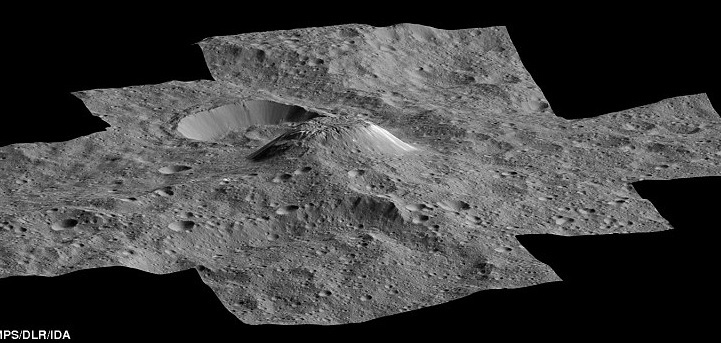
Get out your red/blue glasses and gaze across Ceres at mysterious mountain Ahuna Mons. Shown in a 3D anaglyph perspective view, the mosaicked image data was captured in December of 2015, taken from the Dawn spacecraft's low-altitude mapping orbit about 385 kilometers above the surface of the dwarf planet. A remarkable dome-shaped feature on Ceres, with steep, smooth sides Ahuna Mons is about 20 kilometers (12 miles) in diameter at its base, rising on average 4 kilometers to a flattened summit. Similar in size to mountains found on planet Earth, no other Cerean surface feature is so tall and well-defined. It is not known what process shaped the lonely Ahuna Mons, or if the bright material streaking its steepest side is the same material responsible for Ceres' famous bright spots.
The Ceres mystery deepens: Enigmatic spots on the dwarf planet brighten and fade during the day in random, bizarre patterns Daily Mail - March 16, 2015
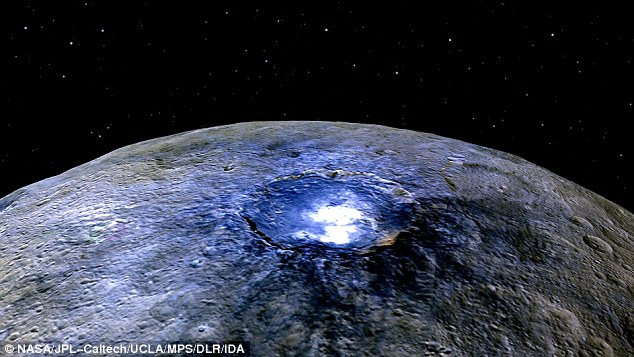
For more than a year, the bright spots on Ceres (pictured) have baffled and fascinated astronomers. Theories range from salt deposits, ice and flashes of light made by aliens. Now, researchers claim the spots are more intriguing than first thought after they discovered they brighten and fade during the day, and do so randomly
The mysterious 'pyramid of Ceres' up close: Stunning new images reveal three mile high mountain has a strange 'glowing' side Daily Mail - March 7, 2015
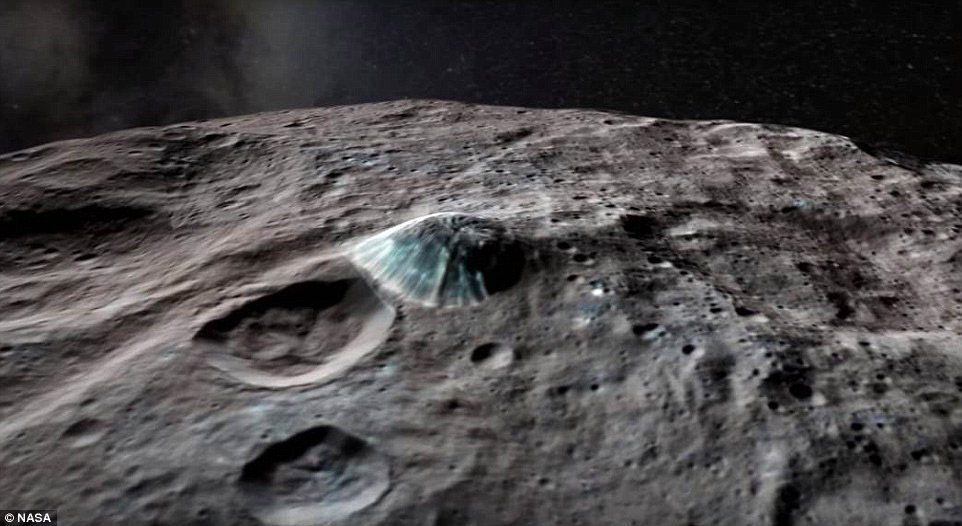
It is one of the many mysteries of Ceres - a gigantic pyramid in among the vast craters and alien spots. Now, Nasa has revealed stunning new close up images of the three mile high mountain Ahuna Mons. They reveal the 'pyramid' is in fact a dome with smooth, steep walls - one of which appears to glow.