
The study of the crop circle phenomena is called Cerealogy. Cerealogists commonly refer to these designs as agriglyphs or landscape art. No one knows how far back in history crop formations go. I prefer to call them crop formation rather than crop circles, because many of the formations are not round.
There are many theories about crop formations:
weather events
planetary or electromagnetic energies and vortices
imprints by extraterrestrials - UFO Drones or Balls of Light
Perhaps there is a degree of truth in all of these theories. Designs by humans had to come from the consciousness of those who created them. The comings and goings of extraterrestrials on planet Earth has become a well-established fact so perhaps the crop formations contain hidden messages and codes that awaken humanity about the future of the planet and the human experiment.
Crop Formations should always be reviewed from above - allowing your mind to translate what you see into animated 3 dimensional holographic forms much like current simulation theory which states that reality emerges from a black hole as two-dimensional sheets that project out into third dimension.
Crop circle formations - like geoglyphs found around the world - are more than just designs on the ground best viewed from above. The three-fold, four-fold, five-fold, six-fold, and highly complex n-fold rotational symmetrical geometric shapes - no matter who designed them - are really very cool. As reality is created by mathematical algorithms and geometric patterns, so too is there a method to the madness of the crop circle phenomenon throughout history.
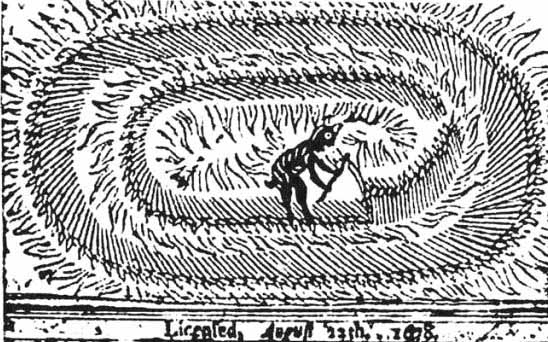
The Mowing Devil allegedly depicts a woodcut dating to 1678 of an early crop circle being created by something or someone unknown resembling the devil from the perspective of the person who created the woodcut.

The 'Mowing-Devil or Strange News out of Hertford-shire' is the title of an English woodcut pamphlet published in 1678. It narrates a tale of Satan mowing a field in Hertfordshire, and presents itself as reporting the news. It has been cited as an early report of crop circles.
The pamphlet tells a "strange" news story of an anonymous farmer in Hertfordshire who, refusing to pay the price demanded by a farmworker to mow his field of oats, swore he would rather the Devil mowed it instead.
According to the pamphlet, that night his field appeared to be in flame. The next morning, the field was found to be perfectly mowed, "that no mortal man was able to do the like".
This pamphlet, and the accompanying illustration, are often cited by crop circle researchers as among the first recorded cases of crop circles.
Crop circle researcher Jim Schnabel does not consider it to be a historical precedent because it describes the stalks as being cut, while modern crop circles involve the wheat, barley or, less commonly, other plants being bent.
There are a handful of documented historical accounts and scientific reports of circular crop formations prior to the modern craze, though they are quite rare. Historically, these early instances were usually blamed on storms, localized winds, or folklore.
In 1686, an English naturalist, Robert Plot, reported on rings or arcs of mushrooms (see fairy rings) in The Natural History of Stafford-Shire, proposing air flows from the sky as a cause. In 1991, meteorologist Terence Meaden linked this report with modern crop circles, a claim that has been compared with those made by Erich von Daniken.
An 1880 letter to the editor of Nature by amateur scientist John Rand Capron describes how several circles of flattened crops in a field were formed under suspicious circumstances and possibly caused by "cyclonic wind action", stating "as viewed from a distance, circular spots ... they all presented much the same character, viz, a few standing stalks as a centre, some prostrate stalks with their heads arranged pretty evenly in a direction forming a circle round the centre, and outside there a circular wall of stalks which had not suffered"
Twentieth Century
In 1932, archaeologist E. C. Curwen observed four dark rings in a field at Stoughton Down near Chichester, but could examine only one: "a circle in which the barley was 'lodged' or beaten down, while the interior area was very slightly mounded up."
In Fortean Times, David Wood reported that in 1940 he made crop circles near Gloucestershire using ropes.
The Tully "Saucer Nest" (1966): In Tully, Queensland, Australia, a banana farmer named George Pedley claimed to see a saucer-shaped UFO rise from a swampy lagoon. When he went to investigate, he found a 30-foot circular patch of flattened, swirling reeds and grass. Local police and scientists concluded it was likely caused by a natural weather phenomenon like a dust devil or waterspout, but the media widely branded it a "flying saucer nest".
A 1948 German story, "Die zwolf Schwane" (The Twelve Swans), features a farmer finding a circular ring of flattened grain every morning, blamed on dancing princesses. Similar stories of flattened circular grass accompanied by lights from the sky exist in Native American Algonquian lore.
In 1963, Patrick Moore described a crater in a potato field in Wiltshire that he considered was probably caused by an unknown meteoric body. In nearby wheat fields, there were several circular and elliptical areas where the wheat had been flattened. There was evidence of "spiral flattening". He thought they could be caused by air currents from the impact, since they led towards the crater. Astronomer Hugh Ernest Butler observed similar craters and said they were likely caused by lightning strikes.
During the 1960s, there were many reports of UFO sightings and circular formations in swamp reeds and sugarcane fields in Tully, Queensland, Australia, and in Canada. For example, on 8 August 1967, three circles were found in a field in Duhamel, Alberta, Canada; Department of National Defence investigators concluded that it was artificial but couldn't say who made them or how.
The most famous case is the 1966 Tully "saucer nest", when a farmer said he witnessed a saucer-shaped craft rise 9 or 12 m (30 or 40 ft) from a swamp and then fly away. On investigating he found a nearly circular area 10 m (32 ft) long by 8 m (25 ft) wide where the grass was flattened in clockwise curves to water level within the circle, and the reeds had been uprooted from the mud.
The local police officer, the Royal Australian Air Force, and the University of Queensland concluded that it was most probably caused by natural causes, like a down draught, a willy-willy (dust devil), or a waterspout.
In 1973, G.J. Odgers, Director of Public Relations, Department of Defence (Air Office), wrote to a journalist that the "saucer" was probably debris lifted by a willy-willy.
After the 1960s, there was a surge of UFOlogists in Wiltshire, and there were rumors of "saucer nests" appearing in the area, but they were never photographed. There are other pre-1970s reports of circular formations, especially in Australia and Canada, but they were always simple circles, which could have been caused by whirlwinds.
British pranksters Doug Bower and Dave Chorley reported they started creating crop circles in British cornfields in 1978, inspired by the Tully "saucer nest" case.
The first film to depict a geometric crop circle, in this case created by super-intelligent ants, was the 1974 science-fiction film Phase IV. The film has been cited as a possible inspiration or influence on the pranksters who started this phenomenon.
The majority of reports of crop circles have appeared and spread since the late 1970s as many circles began appearing throughout the English countryside.
Around this time, researcher Colin Andrews began documenting the phenomenon, and in 1989 he co-authored Circular Evidence with Pat Delgado, a work that compiled reports and photographs of early formations. This phenomenon became widely known in the late 1980s, after the media started to report crop circles in Hampshire and Wiltshire.
In 1991, two self-professed pranksters, Doug Bower and Dave Chorley, made headlines by saying they had started the crop circle phenomenon in 1978, using simple tools consisting of a plank of wood, rope, and a baseball cap fitted with a loop of wire to help them walk in straight lines. To prove their case they made a circle in front of journalists; a "cereologist" (advocate of paranormal explanations of crop circles), Pat Delgado, examined the circle and declared it authentic before it was revealed that it was a hoax. Inspired by Australian crop circle accounts from 1966, Bower and Chorley claimed to be responsible for all circles made prior to 1987, and for more than 200 crop circles in 1978-1991 (with 1,000 other circles not being made by them).
Writing in Physics World, Richard Taylor of the University of Oregon said that "the pictographs they created inspired a second wave of crop artists. Far from fizzling out, crop circles have evolved into an international phenomenon, with hundreds of sophisticated pictographs now appearing annually around the globe.
On the night of July 11-12, 1992, a crop-circle-making competition with a prize of $4,057.95 - funded in part by the Arthur Koestler Foundation- was held in Berkshire. The winning entry was produced by three Westland Helicopters engineers, using rope, PVC pipe, a plank, string, a telescopic device and two stepladders. The experiment was conclusive. Humans could indeed make all the features of state-of-the-art crop formations at that time.
Twenty-first Century
Since the start of the 21st century, crop formations have increased in size and complexity, with some featuring as many as 2,000 different shapes and some incorporating complex mathematical and scientific characteristics.
By 2001, approximately 10,000 crop circles had been reported internationally, from locations such as the former Soviet Union, the United Kingdom, Japan, the U.S., and Canada. Researchers have noted a correlation between crop circles, recent media coverage, and the absence of fencing and/or anti-trespassing legislation.
Although farmers expressed concern at the damage caused to their crops, local response to the appearance of crop circles was often enthusiastic, with locals taking advantage of the increase of tourism and visits from scientists, crop circle researchers, and individuals seeking spiritual experiences. The market for crop circle interest consequently generated bus or helicopter tours of circle sites, walking tours, T-shirts, and book sales.
Researcher Jeremy Northcote found that crop circles in the UK in 2002 were not spread randomly across the landscape. They tended to appear near roads, areas of medium-to-dense population, and cultural heritage monuments such as Stonehenge or Avebury. He found that they always appeared in areas that were easy to access. This suggests strongly that these crop circles were more likely to be caused by intentional human action than by paranormal activity.
Another strong indication of that theory was that inhabitants of the zone with the most circles had a historical tendency for making large-scale formations, including stone circles such as Stonehenge, earthen mounds such as Silbury Hill, long barrows such as West Kennet Long Barrow, and white horses in chalk hills. Read more ...
When it was discovered that humans could create intricate crop circles - the number of formations decreased drastically - and yet there are those who still believe the patterns have a connection to extraterrestrial agendas that go back to the beginning. It would stand to reason that formations have always been of the landscape for varying purposes humans may never completely understand.