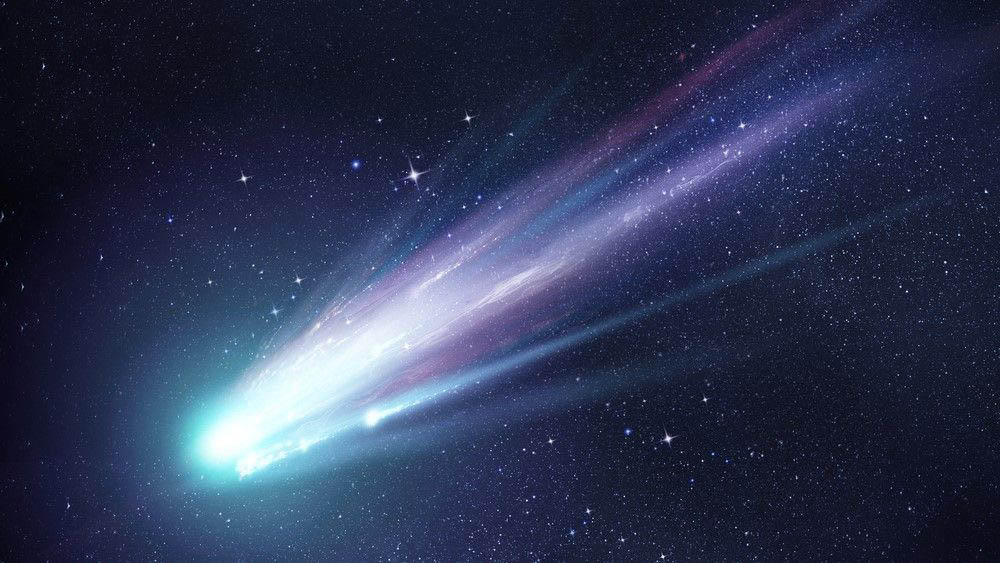
Massive eruption from icy volcanic comet detected in solar system Live Science - December 2, 2022
A bizarre, volcanic comet has violently erupted, spewing out more than 1 million tons of gas, ice and the "potential building blocks of life" into the solar system. The volatile comet, known as 29P/Schwassmann-Wachmann (29P), is around 37 miles (60 kilometers) wide and takes around 14.9 years to orbit the sun. 29P is believed to be the most volcanically active comet in the solar system. It is one of around 100 comets, known as "centaurs," that have been pushed from the Kuiper Belt a ring of icy comets that lurk beyond Neptune - into a closer orbit around the sun between those of Jupiter and Neptune, according to NASA (opens in new tab).
Weird Space Rock Confirmed as Super-Rare Hybrid of Comet And Asteroid Science Alert - October 5, 2021
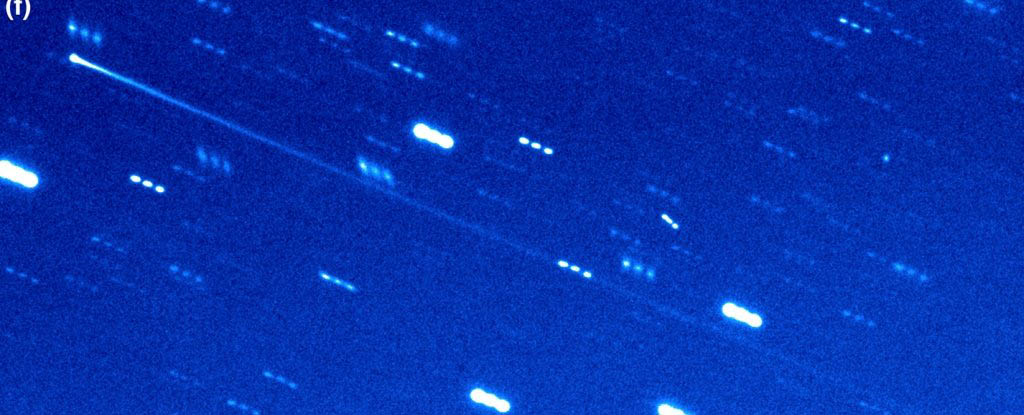
Comets and asteroids are both types of rocks that hang out in space, but their differences are pretty pronounced. Comets typically hail from the outer Solar System and have long, elliptical orbits. They're filled with ices that start to sublimate when the comet gets close to the Sun, generating a dusty, misty atmosphere (called a coma) and the famous cometary tails.
Gigantic Comet Approaching From Outer Solar System May Be The Largest Ever Seen Science Alert - September 30, 2021
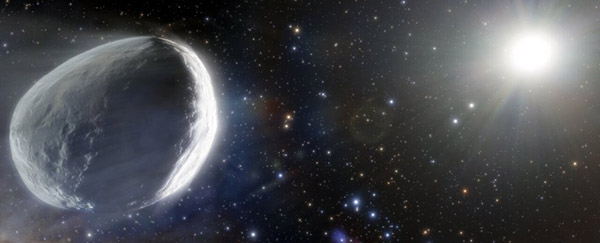
A comet so huge it was initially mistaken for a dwarf planet is on an inward-bound trajectory from the outer Solar System. There's no reason to worry - C/2014 UN271 (Bernardinelli-Bernstein), as the comet is called, will approach no closer to the Sun than just outside the orbit of Saturn. But its large size and relative closeness will afford a rare opportunity to study a pristine object from the Oort Cloud, and find new information about the formation of the Solar System.
Comet Ingredients Swallowed by an Asteroid, Found Sealed Inside a Meteorite Live Science - April 15, 2019
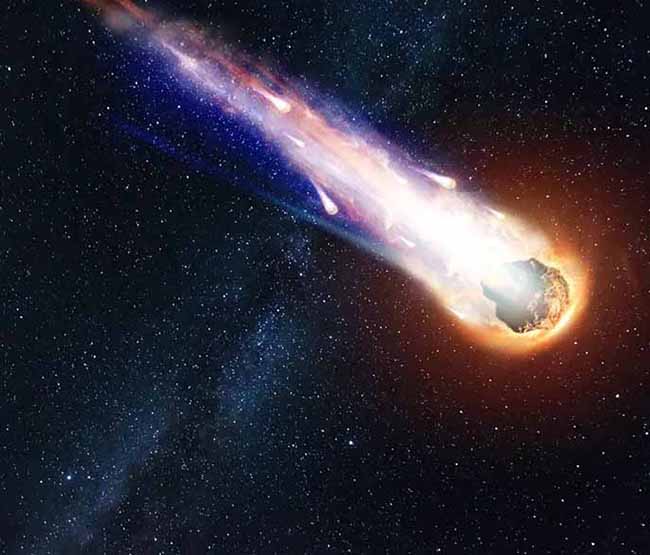
The raw materials from a comet have been found sealed inside a pristine, primitive meteorite. The meteorite was found in the LaPaz icefield of Antarctica and has weathered very little since the time it crashed to Earth. According to a new study published today (April 15) in the journal Nature Astronomy, researchers found that this sample of space rock contains something strange: bits of the building blocks of a comet that became trapped in the meteorite's parent asteroid just 3 million years after the solar system formed. Because this sample of cometary building block material was swallowed by an asteroid and preserved inside this meteorite, it was protected from the ravages of entering Earth's atmosphere.
Comet impacts cook up 'soup of life' BBC - August 19, 2015
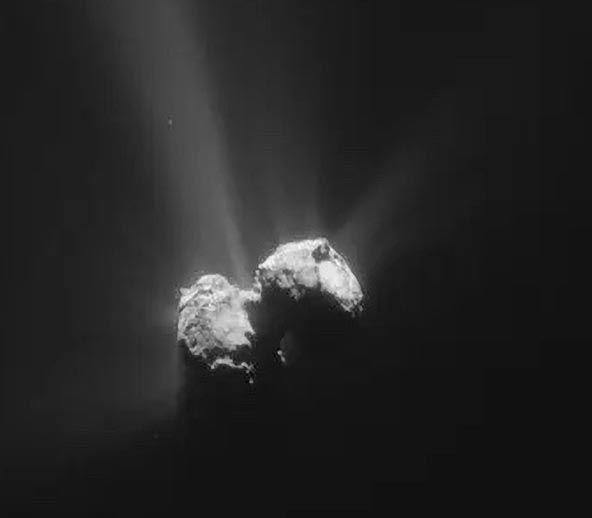
New results show how collisions between comets and planets can make molecules that are the essential building blocks of life. This suggests that the chemistry needed to gather the molecular ingredients for life could be more common than previously recognized. Earth scientists from Japan carried out experiments to mimic comet impacts that occurred on early Earth. They found chemical reactions to make the primordial "soup for life" can occur anywhere that comets collide.
Comet Siding Spring skims past Mars BBC - October 19, 2014
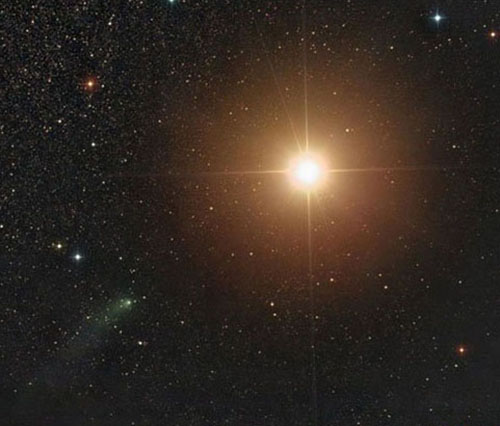
A recently discovered comet has whizzed past Mars, giving scientists a unique chance to study an object from the farthest reaches of the Solar System. The comet, known as Siding Spring, raced past Mars at 56km per second (125,000mph), missing it by 139,500 km. Rovers on the Martian surface and satellites were primed to catch the event on their cameras and instruments.
Comet Siding Spring Passes Mars APOD - October 20, 2014
Yesterday, a comet passed very close to Mars. In fact, Comet C/2013 A1 (Siding Spring) passed closer to the red planet than any comet has ever passed to Earth in recorded history.
First ever evidence of a comet striking Earth PhysOrg - October 8, 2013
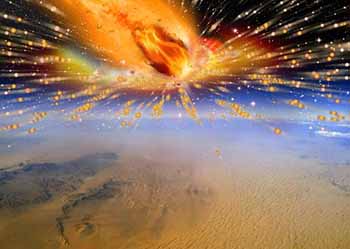
The first ever evidence of a comet entering Earth's atmosphere and exploding, raining down a shock wave of fire which obliterated every life form in its path, has been discovered by a team of South African scientists and international collaborators. The discovery has not only provided the first definitive proof of a comet striking Earth, millions of years ago, but it could also help us to unlock, in the future, the secrets of the formation of our solar system.
Comet's water 'like that of Earth's oceans' BBC - October 6, 2011
Comet Hartley 2 contains water more like that found on Earth than all the comets we know about, researchers say. A study using the Herschel space telescope aimed to measure the fraction of deuterium, a rare type of hydrogen, present in the comet's water. Like our oceans, it had half the amount of deuterium seen from other comets.
Probe sweeps past 'space peanut' BBC - November 4, 2010
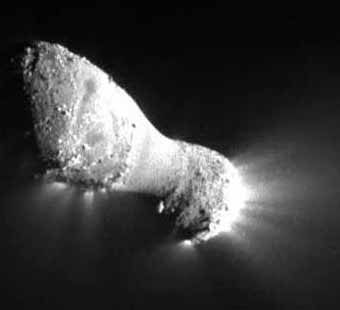
Nasa's Deep Impact probe has flown by Comet Hartley 2. The first pictures revealed a roughly 1.5km-long, peanut-shaped object with jets of gas streaming from its surface. The pass, which occurred about 23 million km from Earth, was only the fifth time a spacecraft had made a close approach to a comet.
First discovery of life's building block in comet made PhysOrg - August 18, 2009
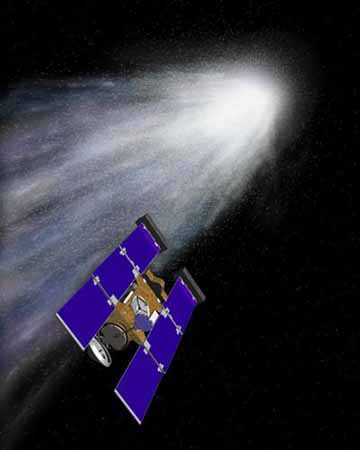
NASA scientists have discovered glycine, a fundamental building block of life, in samples of comet Wild 2 returned by NASA's Stardust spacecraft. "Glycine is an amino acid used by living organisms to make proteins, and this is the first time an amino acid has been found in a comet," said Dr. Jamie Elsila of NASA's Goddard Space Flight Center. Our discovery supports the theory that some of life's ingredients formed in space and were delivered to Earth long ago by meteorite and comet impacts.
Comet Killed Ice Age Beasts Live Science - July 20, 2009
Space rocks that slammed into the glaciers of eastern Canada some 12,900 years ago likely helped wipe out mega-animals like woolly mammoths and possibly the continent's first human inhabitants called the Clovis people, according to a new study that adds to evidence that a trio of factors were involved. The new evidence comes from recently discovered nano-sized diamonds, which researchers say are the strongest clues to date for an argument that could explain the region's die-off during the late Pleistocene epoch. Scientists have long debated what caused this catastrophic extinction event, sending more than three-fourths of North America's large Ice Age animals and the Clovis people to their graves. (The Clovis people were a Stone Age group that had only recently immigrated to the continent.)
California's Channel Islands hold evidence of Clovis-age comets PhysOrg - July 20, 2009
A 17-member team has found what may be the smoking gun of a much-debated proposal that a cosmic impact about 12,900 years ago ripped through North America and drove multiple species into extinction. Colleagues from nine institutions and three private research companies report the presence of shock-synthesized hexagonal diamonds in 12,900-year-old sediments on the Northern Channel Islands off the southern California coast. These tiny diamonds and diamond clusters were buried deeply below four meters of sediment. They date to the end of Clovis - a Paleoindian culture long thought to be North America's first human inhabitants. The nano-sized diamonds were pulled from Arlington Canyon on the island of Santa Rosa that had once been joined with three other Northern Channel Islands in a landmass known as Santarosae. The diamonds were found in association with soot, which forms in extremely hot fires, and they suggest associated regional wildfires, based on nearby environmental records. Such soot and diamonds are rare in the geological record. They were found in sediment dating to massive asteroid impacts 65 million years ago in a layer widely known as the K-T Boundary. The thin layer of iridium-and-quartz-rich sediment dates to the transition of the Cretaceous and Tertiary periods, which mark the end of the Mesozoic Era and the beginning of the Cenozoic Era.
Two Tails of Comet Lulin NASA - February 25, 2009
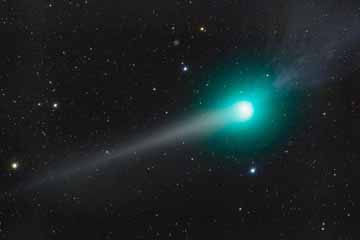
Yesterday, Comet Lulin passed its closest to Earth, so that the comet will remain near its brightest over the next few days. The comet is currently almost 180 degrees around from the Sun and so visible nearly all night long, but will appear to move on the sky about 10 full moons a night. In this image, Comet Lulin was captured in spectacular form two nights ago from New Mexico, USA. The central coma of the comet is appearing quite green, a color likely indicating glowing molecular carbon gasses. Bright stars and a distant spiral galaxy are clearly visible in the image background. The yellow dust tail, reflecting sunlight, is visible sprawling to the coma's left trailing behind the comet, while the textured bluish-glowing ion tail is visible to the coma's right, pointing away from the Sun. Over the past few weeks, from the current vantage point of Earth, these two tails appeared to point in opposite directions. Comet Lulin is expected to slowly fade over the next few weeks.
Six North American Sites Hold 12,900-year-old Nanodiamond-rich Soil Science Daily - January 2, 2009
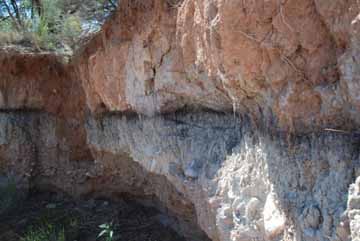
Abundant tiny particles of diamond dust exist in sediments dating to 12,900 years ago at six North American sites, adding strong evidence for Earth's impact with a rare swarm of carbon-and-water-rich comets or carbonaceous chondrites, reports a nine-member scientific team. These nanodiamonds, which are produced under high-temperature, high-pressure conditions created by cosmic impacts and have been found in meteorites, are concentrated in similarly aged sediments at Murray Springs, Ariz., Bull Creek, Okla., Gainey, Mich., and Topper, S.C., as well as Lake Hind, Manitoba, and Chobot, Alberta, in Canada. Nanodiamonds can be produced on Earth, but only through high-explosive detonations or chemical vaporization.
NASA Finds New Type Of Comet Dust Mineral Science Daily - June 17, 2008
NASA researchers and scientists from the United States, Germany and Japan have found a new mineral in material that likely came from a comet. The mineral, a manganese silicide named Brownleeite, was discovered within an interplanetary dust particle, or IDP, that appears to have originated from comet 26P/Grigg-Skjellerup. The comet originally was discovered in 1902 and reappears every 5 years. The team that made the discovery is headed by Keiko Nakamura-Messenger, a space scientist at NASA's Johnson Space Center in Houston. The mineral, a manganese silicide named Brownleeite, was discovered within an interplanetary dust particle, or IDP, that appears to have originated from comet 26P/Grigg-Skjellerup. The comet originally was discovered in 1902 and reappears every 5 years. The team that made the discovery is headed by Keiko Nakamura-Messenger, a space scientist at NASA's Johnson Space Center in Houston.
2007: A Year of Spectacular Comets NASA - December 31, 2007
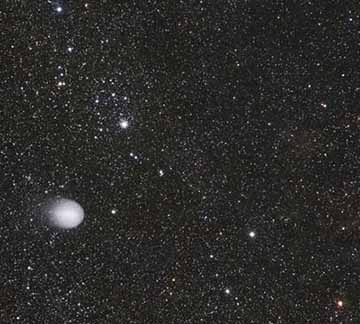
Two spectacular comets graced Earth's skies during 2007. Both comets became bright enough to be seen by the unaided eye of the casual sky enthusiast. Early in 2007, Comet McNaught grew brighter than any comet in 40 years, displaying a beautiful dust tail that flowed across the sky. Comet McNaught (c/2006 P1) became known as the Great Comet of 2007, sported unusual striations in its expansive dust tail, and showed unexpectedly complex chemistry in its ion tail. Toward the year's end, normally docile and faint Comet Holmes brightened suddenly and unexpectedly to naked eye visibility. Remarkably, Comet 17P/Holmes stayed bright for weeks even though it lies beyond the orbit of Mars. No distant comet in recent history has remained so bright for so long. In this view, a white Comet Holmes was photographed in early December posing with the Heart and Soul Nebulas.
Did Life Begin In Space? New Evidence From Comets Science Daily - August 14, 2007
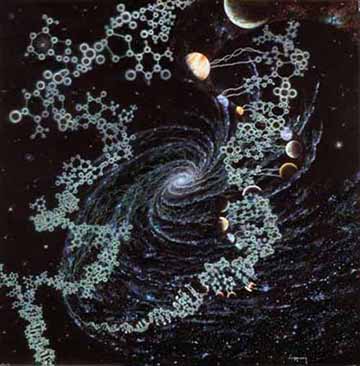
Professor Chandra Wickramasinghe and colleagues at the University's Centre for Astrobiology have long argued the case for panspermia - the theory that life began inside comets and then spread to habitable planets across the galaxy. A recent BBC Horizon documentary traced the development of the theory. Now the team claims that findings from space probes sent to investigate passing comets reveal how the first organisms could have formed. The 2005 Deep Impact mission to Comet Tempel 1 discovered a mixture of organic and clay particles inside the comet. One theory for the origins of life proposes that clay particles acted as a catalyst, converting simple organic molecules into more complex structures. The 2004 Stardust Mission to Comet Wild 2 found a range of complex hydrocarbon molecules - potential building blocks for life.
Stardust capsule returns to Earth BBC - January 15, 2006

A capsule containing comet particles and interstellar dust has landed on Earth after a seven-year space mission. The Stardust probe released the capsule as it flew back to Earth after a 4.6-billion-km (2.8-billion-mile) trip. The US-built capsule plunged through the atmosphere and touched down in the Utah desert at 0312 (1012 GMT). Scientists believe the first cometary dust samples ever returned to Earth will shed light on the origins of the Solar System. Mission controllers at the US space agency's (Nasa) Jet Propulsion Laboratory in Pasadena, California, clapped and cheered as the capsule began its plunge to Earth. Four hours after leaving the probe, the capsule entered the Earth's atmosphere 125km (410,000ft) over the Pacific Ocean.