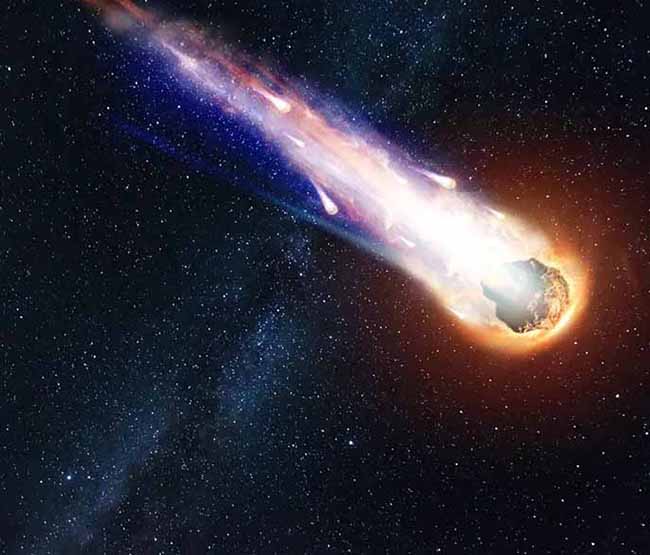
A comet is basically a ball of ice and dust that looks like a star with a tail.
Some comets do not have tails, looking like hazy, round spots of light.
A comet is basically a ball of ice and dust that looks like a star with a tail.
Some comets do not have tails, looking like hazy, round spots of light.
Some comets are moved into sun grazing orbits that destroy the comets when they near the Sun, while others are thrown out of the solar system forever. A new comet may be discovered photographically using a wide-field telescope or visually with binoculars. However, even without access to optical equipment, it is still possible for the amateur astronomer to discover a sun grazing comet online.
Most comets are believed to originate in a cloud (the Oort cloud) at large distances from the Sun consisting of debris left over from the condensation of the solar nebula; the outer edges of such nebulae are cool enough that water exists in a solid (rather than gaseous) state. Asteroids originate via a different process, but very old comets which have lost all their volatile materials may come to resemble asteroids.
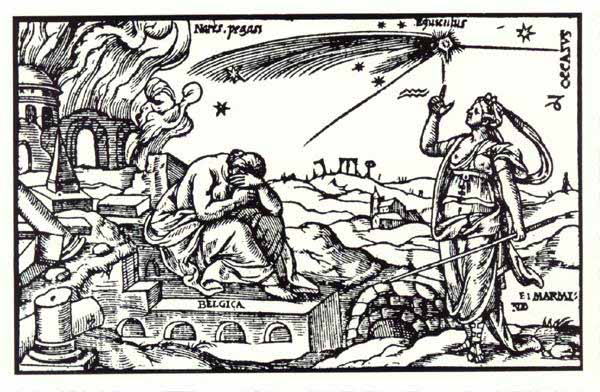
Historically, comets were thought to be unlucky, harbingers of destruction by anthropomorphic gods, or aliens, against humans. People are programmed to fear the unknown, but through scientific discovery, as with everything else along the way to enlightenment, there is always a physical explanation. Read more ...
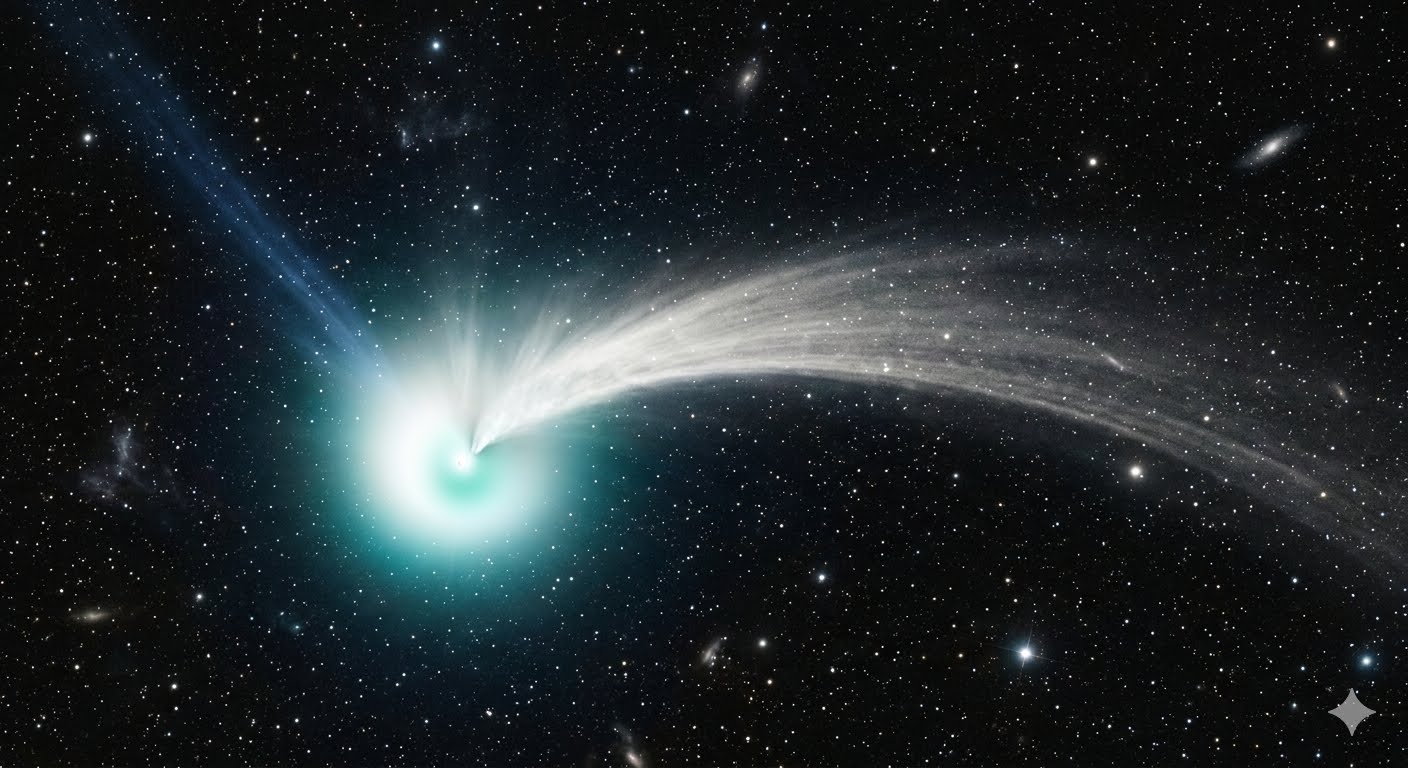
The coma is the glowing, spherical green head on the upper left side. The Core is the tiny intense white point at the center of that green glow - the nucleus (the solid ice and rock core). The Glow is the round cyan-green shroud around the coma.
The Coma consists of sublimated ice, gas, and dust. It is formed by heat from the Sun which warms the nucleus, causing it to vent materials into space. The coma can grow larger than the diameter of Jupiter, even though the nucleus inside is only a few kilometers wide.The long white and blue streams stretching to the bottom right are the tails, which are pushed away from the coma by solar wind and sunlight.
The coma is the nebulous envelope around the nucleus of a comet, formed when the comet passes near the Sun in its highly elliptical orbit. As the comet warms, parts of it sublimate; this gives a comet a diffuse appearance when viewed through telescopes and distinguishes it from stars. The word coma comes from a Greek word meaning "hair" and is the origin of the word comet itself.
The coma is generally made of ice and comet dust. Water composes up to 90% of the volatiles that outflow from the nucleus when the comet is within 3–4 au (280–370 million mi; 450–600 million km) from the Sun. The H2O parent molecule is destroyed primarily through photodissociation and to a much smaller extent photoionization. The solar wind plays a minor role in the destruction of water compared to photochemistry. Larger dust particles are left along the comet's orbital path while smaller particles are pushed away from the Sun into the comet's tail by light pressure.
On 11 August 2014, astronomers released studies, using the Atacama Large Millimeter/Submillimeter Array (ALMA) for the first time, that detailed the distribution of HCN, HNC, H2CO, and dust inside the comae of comets C/2012 F6 (Lemmon) and C/2012 S1 (ISON).
Read more ...
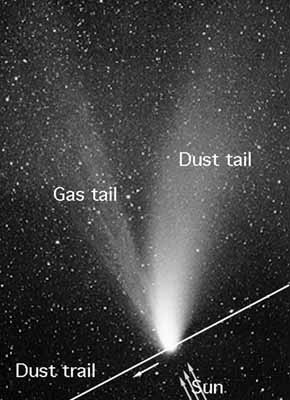
A comet tail - and coma - are features visible in comets when they are illuminated by the Sun and may become visible from Earth when a comet passes through the inner Solar System. As a comet approaches the inner Solar System, solar radiation causes the volatile materials within the comet to vaporize and stream out of the nucleus, carrying dust away with them. Separate tails are formed of dust and gases, becoming visible through different phenomena; the dust reflects sunlight directly and the gases glow from ionization. Most comets are too faint to be visible without the aid of a telescope, but a few each decade become bright enough to be visible to the naked eye. Continue reading
Colossal tail trails dying star BBC - August 15, 2007
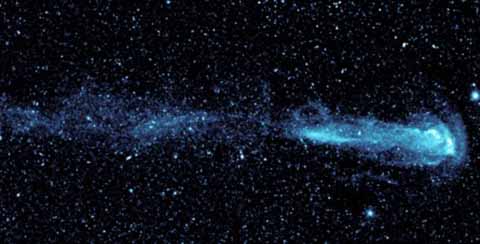
A distant star that hurtles through space at extraordinary speeds has a huge, comet-like tail trailing in its wake, astronomers say. The appendage, which measures a colossal 13 light years in length, was spotted by Nasa's Galaxy Evolution Explorer (Galex) space telescope. The researchers said that nothing like it had ever been spotted around a star. They believe the star, known as Mira, will help them to study what happens as stars meet their demise.
'Dark Comets' Come in Different Varieties, And It Could Have Implications For Life on Earth Science Alert - December 11, 2024
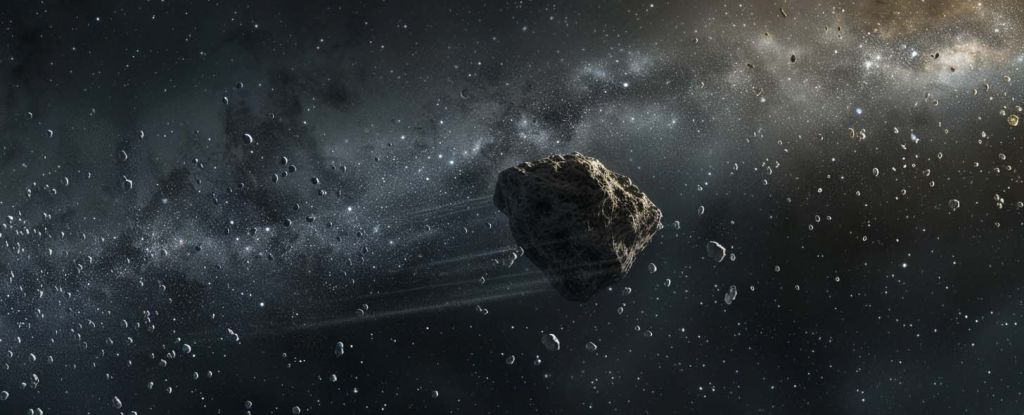
Dark comets look like asteroids, but behave like a comet. The identity of these objects was unveiled in 2023, with first one dark comet, and then six more. Now, an international team of astronomers has unmasked another seven, doubling the number and bringing the total known to 14. This new data reveals that not even all dark comets are the same: there are at least two different kinds. The discovery of multiple kinds of dark comets could tell us more about how Earth was made habitable for life.
Astronomers discover more dark comets - a celestial object that looks like an asteroid but moves through space like a comet PhysOrg - December 9, 2024
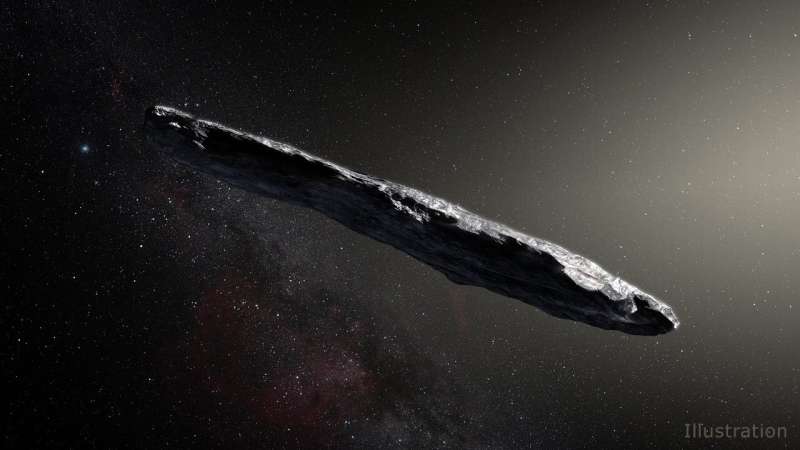
There are two kinds of dark comets: outer dark comets and inner dark comets
Study highlights role of dark comets and active asteroids in delivering water to Earth NDTV - July 17, 2024
There is a new class of space objects known as "dark comets" that astronomers have discovered that may provide information on the origins of Earth's water. These enigmatic objects could account for as much as 60% of all near-Earth objects; they seem to be asteroids with ice hidden beneath their surface. Dark comets are not blurry like regular comets' coma and tail. On the other hand, they show an inexplicable acceleration, suggesting the existence of unobserved emissions, most likely due to sublimating ice. Researchers believe these dark comets originate from the asteroid belt between Mars and Jupiter. Through computer simulations, they were able to mimic the dark comets' orbits and trace them back to the inner part of the asteroid belt. This finding supports the long-held theory that icy materials are common within the asteroid belt. The discovery of dark comets strengthens the possibility that icy objects delivered water to Earth early in its formation. This idea is further bolstered by the existence of "active asteroids"-objects t that display comet-like behavior within the asteroid belt. While the exact connection between dark comets and active asteroids remains unclear, both types of objects could be key players in the story of Earth's water. Future studies will likely shed more light on these intriguing celestial bodies.
Historically, comets were thought to be unlucky, or even interpreted as attacks by heavenly beings against terrestrial inhabitants. Some authorities interpret references to "falling stars" in Gilgamesh, Revelation and the Book of Enoch as references to comets, or possibly bolides - either an extraterrestrial body that collides with the Earth, or to an exceptionally bright, fireball-like meteor regardless of whether it ultimately impacts the surface.
In the first book of his Meteorology, Aristotle propounded the view of comets that would hold sway in Western thought for nearly two thousand years. He rejected the ideas of several earlier philosophers that comets were planets, or at least a phenomenon related to the planets, on the grounds that while the planets confined their motion to the circle of the Zodiac, comets could appear in any part of the sky.
Instead, he described comets as a phenomenon of the upper atmosphere, where hot, dry exhalations gathered and occasionally burst into flame. Aristotle held this mechanism responsible for not only comets, but also meteors, the aurora borealis, and even the Milky Way.
A few later classical philosophers did dispute this view of comets. Seneca the Younger, in his Natural Questions, observed that comets moved regularly through the sky and were undisturbed by the wind, behavior more typical of celestial than atmospheric phenomena. While he conceded that the other planets do not appear outside the Zodiac, he saw no reason that a planet-like object could not move through any part of the sky, humanity's knowledge of celestial things being very limited.
However, the Aristotelean viewpoint proved more influential, and it was not until the 16th century that it was demonstrated that comets must exist outside the earth's atmosphere.
In 1577, a bright comet was visible for several months. The Danish astronomer Tycho Brahe used measurements of the comet's position taken by himself and other, geographically separated observers to determine that the comet had no measureable parallax. Within the precision of the measurements, this implied the comet must be at least four times more distant from the earth than the moon.
Although comets had now been demonstrated to be in the heavens, the question of how they moved through the heavens would be debated for most of the next century. Even after Johannes Kepler had determined in 1609 that the planets moved about the sun in elliptical orbits, he was reluctant to believe that the laws that governed the motions of the planets should also influence the motion of other bodies - he believed that comets travel among the planets along straight lines. Galileo Galilei, although a staunch Copernicanist, rejected Tycho's parallax measurements and held to the Aristotelean notion of comets moving on straight lines through the upper atmosphere.
The first suggestion that Kepler's laws of planetary motion should also apply to the comets was made by William Lower in 1610.
In the following decades, other astronomers, including Pierre Petit, Giovanni Borelli, Adrien Auzout, Robert Hooke, Johann Baptist Cysat, and Jean-Dominique Cassini, all argued for comets curving about the sun on elliptical or parabolic paths, while others, such as Christian Huygens and Johannes Hevelius, supported comets' linear motion.
The matter was resolved by the bright comet that was discovered by Gottfried Kirch on November 14, 1680. Astronomers throughout Europe tracked its position for several months.
In his Principia Mathematica of 1687, Isaac Newton proved that an object moving under the influence of his inverse square law of universal gravitation must trace out an orbit shaped like one of the conic sections, and he demonstrated how to fit a comet's path through the sky to a parabolic orbit, using the comet of 1680 as an example.
Newton described comets as compact, solid, fixed, and durable bodies: in one word, a kind of planets, which move in very oblique orbits, every way, with the greatest freedom, persevering in their motions even against the course and direction of the planets; and their tail as a very thin, slender vapor, emitted by the head, or nucleus of the comet, ignited or heated by the sun.
Comets also seemed to Newton absolutely requisite for the conservation of the water and moisture of the planets; from their condensed vapors and exhalations all that moisture which is spent on vegetations and putrefactions, and turned into dry earth, might be resupplied and recruited; for all vegetables were thought to increase wholly from fluids, and turn by putrefaction into earth. Hence the quantity of dry earth must continually increase, and the moisture of the globe decrease, and at last be quite evaporated, if it have not a continual supply. Newton suspected that the spirit which makes the finest, subtilest, and best part of our air, and which is absolutely requisite for the life and being of all things, came principally from the comets.
In 1705, Edmond Halley applied Newton's method to twenty-four cometary apparitions that had occurred between 1337 and 1698. He noted that three of these, the comets of 1531, 1607, and 1682, had very similar orbital elements, and he was further able to account for the slight differences in their orbits in terms of gravitational perturbation by Jupiter and Saturn. Confident that these three apparitions had been three appearances of the same comet, he predicted that it would appear again in 1758-9.
(Earlier, Robert Hooke had identified the comet of 1664 with that of 1618, [N] while Jean-Dominique Cassini had suspected the identity of the comets of 1577, 1665, and 1680. Both were incorrect.)
Halley's predicted return date was later refined by a team of three French mathematicians: Alexis Clairaut, Joseph Lalande, and Nicole-Reine Lepaute, who predicted the date of the comet's 1759 perihelion to within one month's accuracy.
When the comet returned as predicted, it became known as Comet Halley or Halley's Comet (its official designation is 1P/Halley). Its next appearance is due in 2061.
Among the comets with short enough periods to have been observed several times in the historical record, Comet Halley is unique in consistently being bright enough to be visible to the naked eye.
Since the confirmation of Comet Halley's periodicity, many other periodic comets have been discovered through the telescope.
The second comet to be discovered to have a periodic orbit was Comet Encke (official designation 2P/Encke). Over the period 1819-1821 the German mathematician and physicist Johann Franz Encke computed orbits for a series of cometary apparitions observed in 1786, 1795, 1805, and 1818, concluded they were same comet, and successfully predicted its return in 1822.
As early as the 18th century, some scientists had made correct hypotheses as to comets' physical composition. In 1755, Immanuel Kant hypothesized that comets are composed of some volatile substance, whose vaporization gives rise to their brilliant displays near perihelion. In 1836, the German mathematician Friedrich Wilhelm Bessel, after observing streams of vapor in the 1835 apparition of Comet Halley, proposed that the jet forces of evaporating material could be great enough to significantly alter a comet's orbit and argued that the non-gravitational movements of Comet Encke resulted from this mechanism.
However, another comet-related discovery overshadowed these ideas for nearly a century. Over the period 1864-1866 the Italian astronomer Giovanni Schiaparelli computed the orbit of the Perseid meteors, and based on orbital similarities, correctly hypothesized that the Perseids were fragments of Comet Swift-Tuttle. The link between comets and meteor showers was dramatically underscored when in 1872, a major meteor shower occurred from the orbit of Comet Biela, which had been observed to split into two pieces during its 1846 apparition, and never seen again after 1852. A "gravel bank" model of comet structure arose, according to which comets consist of loose piles of small rocky objects, coated with an icy layer.
By 1900, seventeen comets had been observed at more than one perihelion passage and recognized as periodic comets.
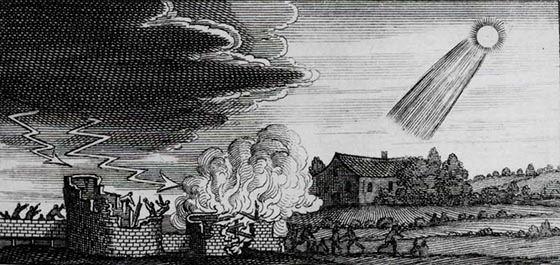
Comets in Ancient Cultures
- NASA November 20, 2013Comets have inspired dread, fear, and awe in many different cultures and societies around the world and throughout time. They have been branded with such titles as "the Harbinger of Doom" and "the Menace of the Universe." They have been regarded both as omens of disaster and messengers of the gods. Why is it that comets are some of the most feared and venerated objects in the night sky? Why did so many cultures cringe at the sight of a comet? They believed costs were messages from the gods or a fiery sword blazing across the night sky, a traditional sign of war and death. The Roman prophecies, the "Sibylline Oracles," spoke of a "great conflagration from the sky, falling to earth," while the most ancient known mythology, the Babylonian "Epic of Gilgamesh," described fire, brimstone, and flood with the arrival of a comet.
About once a year, on the average, there will appear a comet bright enough to be visible with the naked eye, and the so-called "Great Comets," which are those that are conspicuous to the naked eyes of even non-astronomers, appear about once every decade or so.
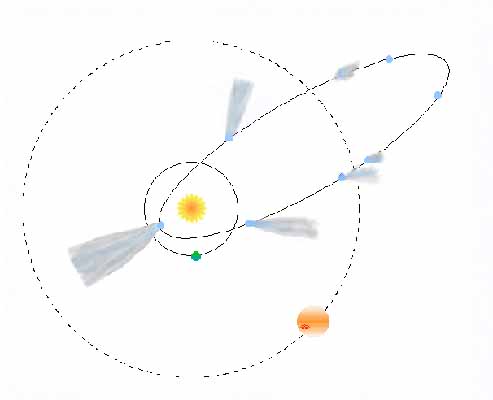
Comets travel around the sun in paths called 'ellipses'.
Comets have highly elliptical orbits that bring them very close to the Sun and swing them deeply into space, often beyond the orbit of Pluto. While most of the planets' orbits are near-circles, the orbits of most comets are extremely elongated ellipses. That point on the comet's orbit that is closest to the sun is called "perihelion." Because a comet experiences its strongest solar heating at its perihelion point, that is usually when it is brightest.
Occasionally, comets have been known to experience "outbursts" when their brightnesses increase dramatically within a short period of time. This can be due to a fresh eruption of new material from a comet's surface, or sometimes this occurs when the nucleus splits into two or more pieces, exposing previously hidden sections of its material to the sun's heat for the first time.
Some comets travel is such long orbit that they are near the sun once in thousands of years. All comets are part of the suns family, just as the Earth and the other planets.
As comets approach the Sun they develop enormous tails of luminous material that extend for millions of kilometers from the head, away from the Sun. When far from the Sun, the nucleus is very cold and its material is frozen solid within the nucleus. In this state comets are sometimes referred to as a "dirty iceberg" or "dirty snowball," since over half of their material lumps of frozen gas and rock.
When a comet approaches within close to the Sun, the surface of the nucleus begins to warm, and volatiles evaporate. The evaporated molecules boil off and carry small solid particles with them, forming the comet's coma of gas and dust.
When the nucleus is frozen, it can be seen only by reflected sunlight. However, when a coma develops, dust reflects still more sunlight, and gas in the coma absorbs ultraviolet radiation and begins to fluoresce. At about 5 AU from the Sun, fluorescence usually becomes more intense than reflected light.
As the comet absorbs ultraviolet light, chemical processes release hydrogen, which escapes the comet's gravity, and forms a hydrogen envelope. This envelope cannot be seen from Earth because its light is absorbed by our atmosphere, but it has been detected by spacecraft.
The Sun's radiation pressure and solar wind accelerate materials away from the comet's head at differing velocities according to the size and mass of the materials. Thus, relatively massive dust tails are accelerated slowly and tend to be curved. The ion tail is much less massive, and is accelerated so greatly that it appears as a nearly straight line extending away from the comet opposite the Sun.
Each time a comet visits the Sun, it loses some of its volatiles. Eventually, it becomes just another rocky mass in the solar system. For this reason, comets are said to be short-lived, on a cosmological time scale. Many scientists believe that some asteroids are extinct comet nuclei, comets that have lost all of their volatiles.
Comets probably formed at the same time as the Sun and planets, about 4.5 billion years ago. But many of them were kicked far from the Sun by the powerful gravity of the outer planets. The make up comets is found in sedimentary rocks on Earth.
Astronomers suspect that as many as one trillion of these objects reside in a shell, called the Oort Cloud, that extends as much as a light-year from the Sun. Because comets are so tiny, though, no one has ever seen a cometary body inside the Oort Cloud.
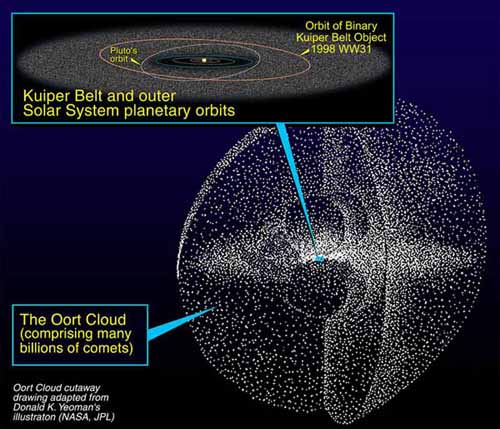
TheOort cloud is a postulated spherical cloud of comets situated about 50,000 to 100,000 AU from the Sun. This is approximately 1000 times the distance from the Sun to Pluto or roughly one light year, almost a quarter of the distance from the Sun to Proxima Centauri, the star nearest the Sun.
The Oort cloud would have its inner disk at the ecliptic from the Kuiper belt. Although no direct observations have been made of such a cloud, it is believed to be the source of most or all comets entering the inner solar system (some short-period comets may come from the Kuiper belt), based on observations of the orbits of comets.
In 1932 Ernst Opik, an Estonian astronomer, proposed that comets originate in an orbiting cloud situated at the outermost edge of the solar system.
In 1950 the idea was revived and proposed by Dutch astronomer Jan Hendrick Oort to explain an apparent contradiction: comets are destroyed by several passes through the inner solar system, yet if the comets we observe had existed since the origin of the solar system, all would have been destroyed by now. According to the hypothesis, the Oort cloud contains millions of comet nuclei, which are stable because the sun's radiation is very weak at their distance.
The cloud provides a continual supply of new comets, replacing those that are destroyed. It is believed that the total mass of comets in the Oort cloud is many times that of Earth, and estimates range between five and 100 Earth masses. It is a remnant of the original nebula that collapsed to form the Sun and planets five billion years ago, and is loosely bound to the solar system.
The most widely-accepted hypothesis of its formation is that the Oort cloud's objects initially formed much closer to the Sun as part of the same process that formed the planets and asteroids, but that gravitational interaction with young gas giants such as Jupiter ejected them into extremely long elliptical or parabolic orbits. This process also served to scatter the objects out of the ecliptic plane, explaining the cloud's spherical distribution. While on the distant outer regions of these orbits, gravitational interaction with nearby stars further modified their orbits to make them more circular. It is thought that other stars are likely to possess Oort clouds of their own, and that the outer edges of two nearby stars' Oort clouds may sometimes overlap, causing the occasional intrusion of a comet into the inner solar system. The star with the greatest possibility of perturbing the Oort cloud in the next 10 million years is Gliese 710.
Billions more of these icy bodies orbit the Sun in the Kuiper Belt, which begins just beyond the orbit of Neptune. Astronomers have discovered several dozen large, icy bodies orbiting beyond Neptune, and perhaps a couple of dozen smaller ones.
English astronomer Edmund Halley was the first person to suggest that comets are members of our solar system. Halley thought that several of the bright comets recorded long before he was born might really be a single comet approaching the Sun once every 76 years or so. The comet was recorded in 1531, 1607, and 1682. Halley predicted the comet would appear again in 1758. When it did, Halley's theory was proved correct. Comet Halley was named in his honor. It last approached the Sun in 1986, and will return again in 2061.
Several countries sent probes to study Comet Halley in 1986. In particular, the European Giotto spacecraft imaged the comet from close range. It found that Halley is about 10 miles (16 km) long and five miles (8 km) wide, and is coated with organic molecules that make Halley's surface darker than charcoal. Giotto's images showed "jets" of gas spewing off the comet's surface. These jets can be strong enough to change a comet's orbit.
Many comets have probably slammed into Earth during our planet's history, causing global destruction. In 1994, Comet Shoemaker-Levy 9 rammed into Jupiter. Jupiter's powerful gravity pulled the comet apart long before it reached Jupiter, so the planet was pelted by almost two dozen impacts, which created Earth-sized scars in Jupiter's cloud tops. Some of these dark markings lasted for several months.
Although comets had now been demonstrated to be in the heavens, the question of how they moved through the heavens would be debated for most of the next century. Even after Johannes Kepler had determined in 1609 that the planets moved about the sun in elliptical orbits, he was reluctant to believe that the laws that governed the motions of the planets should also influence the motion of other bodies - he believed that comets travel among the planets along straight lines. Galileo Galilei, although a staunch Copernicanist, rejected Tycho's parallax measurements and held to the Aristotelian notion of comets moving on straight lines through the upper atmosphere.
The first suggestion that Kepler's laws of planetary motion should also apply to the comets was made by William Lower in 1610. In the following decades other astronomers, including Pierre Petit, Giovanni Borelli, Adrien Auzout, Robert Hooke, Johann Baptist Cysat, and Giovanni Domenico Cassini all argued for comets curving about the sun on elliptical or parabolic paths, while others, such as Christian Huygens and Johannes Hevelius, supported comets' linear motion.
The matter was resolved by the bright comet that was discovered by Gottfried Kirch on November 14, 1680. Astronomers throughout Europe tracked its position for several months. In 1681, the Saxon pastor Georg Samuel Doerfel set forth his proofs that comets are heavenly bodies moving in parabolas of which the sun is the focus. Then Isaac Newton, in his Principia Mathematica of 1687, proved that an object moving under the influence of his inverse square law of universal gravitation must trace out an orbit shaped like one of the conic sections, and he demonstrated how to fit a comet's path through the sky to a parabolic orbit, using the comet of 1680 as an example.
In 1705, Edmond Halley applied Newton's method to twenty-four cometary apparitions that had occurred between 1337 and 1698. He noted that three of these, the comets of 1531, 1607, and 1682, had very similar orbital elements, and he was further able to account for the slight differences in their orbits in terms of gravitational perturbation by Jupiter and Saturn. Confident that these three apparitions had been three appearances of the same comet, he predicted that it would appear again in 1758-9. Earlier, Robert Hooke had identified the comet of 1664 with that of 1618, while Jean-Dominique Cassini had suspected the identity of the comets of 1577, 1665, and 1680. Both were incorrect. Halley's predicted return date was later refined by a team of three French mathematicians: Alexis Clairaut, Joseph Lalande, and Nicole-Reine Lepaute, who predicted the date of the comet's 1759 perihelion to within one month's accuracy. When the comet returned as predicted, it became known as Comet Halley or Halley's Comet (its official designation is 1P/Halley). Its next appearance will be in 2061.
Among the comets with short enough periods to have been observed several times in the historical record, Comet Halley is unique in consistently being bright enough to be visible to the naked eye. Since the confirmation of Comet Halley's periodicity, many other periodic comets have been discovered through the telescope. The second comet to be discovered to have a periodic orbit was Comet Encke (official designation 2P/Encke). Over the period 1819-1821 the German mathematician and physicist Johann Franz Encke computed orbits for a series of cometary apparitions observed in 1786, 1795, 1805, and 1818, concluded they were same comet, and successfully predicted its return in 1822. By 1900, seventeen comets had been observed at more than one perihelion passage and recognized as periodic comets. As of April 2006, 175 comets have achieved this distinction, though several have since been destroyed or lost.
Isaac Newton described comets as compact, solid, fixed, and durable bodies: in other words, a kind of planet, which move in very oblique orbits, every way, with the greatest freedom, persevering in their motions even against the course and direction of the planets; and their tail as a very thin, slender vapor, emitted by the head, or nucleus of the comet, ignited or heated by the sun. Comets also seemed to Newton absolutely requisite for the conservation of the water and moisture of the planets; from their condensed vapors and exhalations all that moisture which is spent on vegetations and putrefactions, and turned into dry earth, might be resupplied and recruited; for all vegetables were thought to increase wholly from fluids, and turn by putrefaction into earth.
Hence the quantity of dry earth must continually increase, and the moisture of the globe decrease, and at last be quite evaporated, if it have not a continual supply. Newton suspected that the spirit which makes the finest, subtilest, and best part of our air, and which is absolutely requisite for the life and being of all things, came principally from the comets.
Another use which he conjectured comets might be designed to serve, is that of recruiting the sun with fresh fuel, and repairing the consumption of his light by the streams continually sent forth in every direction from that luminary.
As early as the 18th century, some scientists had made correct hypotheses as to comets' physical composition. In 1755, Immanuel Kant hypothesized that comets are composed of some volatile substance, whose vaporization gives rise to their brilliant displays near perihelion.
In 1836, the German mathematician Friedrich Wilhelm Bessel, after observing streams of vapor in the 1835 apparition of Comet Halley, proposed that the jet forces of evaporating material could be great enough to significantly alter a comet's orbit and argued that the non-gravitational movements of Comet Encke resulted from this mechanism.
However, another comet-related discovery overshadowed these ideas for nearly a century. Over the period 1864-1866 the Italian astronomer Giovanni Schiaparelli computed the orbit of the Perseid meteors, and based on orbital similarities, correctly hypothesized that the Perseids were fragments of Comet Swift-Tuttle. The link between comets and meteor showers was dramatically underscored when in 1872, a major meteor shower occurred from the orbit of Comet Biela, which had been observed to split into two pieces during its 1846 apparition, and never seen again after 1852. A "gravel bank" model of comet structure arose, according to which comets consist of loose piles of small rocky objects, coated with an icy layer.
By the middle of the twentieth century, this model suffered from a number of shortcomings: in particular, it failed to explain how a body that contained only a little ice could continue to put on a brilliant display of evaporating vapor after several perihelion passages. In 1950, Fred Lawrence Whipple proposed that rather than being rocky objects containing some ice, comets were icy objects containing some dust and rock. This "dirty snowball" model soon became accepted. It was confirmed when an armada of spacecraft (including the European Space Agency's Giotto probe and the Soviet Union's Vega 1 and Vega 2) flew through the coma of Halley's comet in 1986 to photograph the nucleus and observed the jets of evaporating material. The American probe Deep Space 1 flew past the nucleus of Comet Borrelly on September 21, 2001 and confirmed that the characteristics of Comet Halley are common on other comets as well.
Although comets formed in the outer Solar System, radial mixing of material during the early formation of the Solar System is thought to have redistributed material throughout the proto-planetary disk, so comets also contain crystalline grains which were formed in the hot inner Solar System. This is seen in comet spectra as well as in sample return missions.
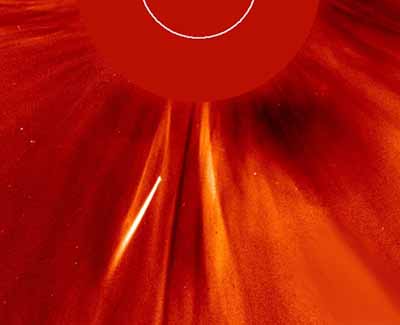
A Sungrazing comet is a comet that passes extremely close to the Sun at perihelion, sometimes within a few thousand kilometres of the Sun's surface. While small sungrazers can be completely evaporated during such a close approach to the Sun, larger sungrazers can survive many perihelion passages. However, the strong tidal forces they experience often lead to their fragmentation.
About 90% of the sungrazers observed with SOHO are member of the Kreutz group, which all originate from one giant comet that broke up into many smaller comets during its first passage through the inner solar system, The other 10% contains some sporadic sungrazers, but four other related groups of comets have been identified among them: the Kracht, Kracht 2a, Marsden and Meyer groups. The Marsden and Kracht groups both appear to be related to Comet 96P/Machholz, which is also the parent of two meteor streams, the Quadrantids and the Arietids.
Of the thousands of known comets, some are very unusual. Comet Encke orbits from outside the main asteroid belt to inside the orbit of Mercury while Comet 29P/Schwassmann-Wachmann orbits in a nearly circular orbit entirely between Jupiter and Saturn. 2060 Chiron, whose unstable orbit keeps it between Saturn and Uranus, was originally classified as an asteroid until a faint coma was noticed. Similarly, Comet Shoemaker-Levy 2 was originally designated asteroid 1990 UL3. Some near-earth asteroids are thought to be extinct nuclei of comets which no longer experience outgassing.
Some comets have been observed to break up during their perihelion passage, including great comets West and Comet Ikeya-Seki. Comet Biela was one significant example, breaking into two during its 1846 perihelion passage. The two comets were seen separately in 1852, but never again after that. Instead, spectacular meteor showers were seen in 1872 and 1885 when the comet should have been visible. A lesser meteor shower, the Andromedids, occurs annually in November, and is caused by the Earth crossing Biela's orbit.
Another very significant cometary disruption was that of Comet Shoemaker-Levy 9, which was discovered in 1993. At the time of its discovery, the comet was in orbit around Jupiter, having been captured by the planet during a very close approach in 1992. This close approach had already broken the comet into hundreds of pieces, and over a period of 6 days in July 1994, these pieces slammed into Jupiter's atmosphere - the first time astronomers had observed a collision between two objects in the solar system. It has also been suggested that the object likely to have been responsible for the Tunguska Event in 1908 was a fragment of Comet Encke.
List of Comets Wikipedia
Comet Vintages Wikipedia