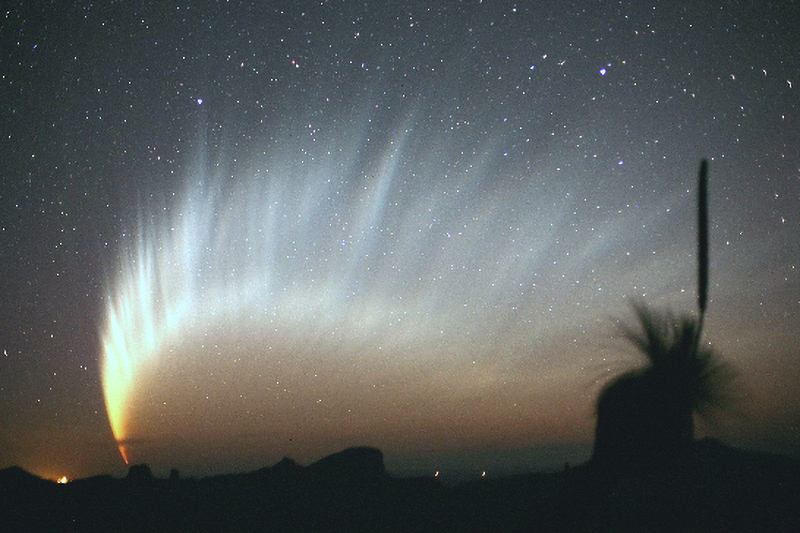
Comet McNaught, also known as the Great Comet of 2007 and given the designation C/2006 P1, is a non-periodic comet discovered on August 7, 2006 by British-Australian astronomer Robert H. McNaught using the Uppsala Southern Schmidt Telescope.
It was the brightest comet in over 40 years, and was easily visible to the naked eye for observers in the Southern Hemisphere in January and February 2007. With an estimated peak magnitude of -5.5, the comet was the second brightest since 1935.
Around perihelion on January 12, it was visible worldwide in broad daylight. Its tail measured an estimated 35 degrees in length at its peak. The brightness of C/2006 P1 near perihelion was enhanced by forward scattering. Read More ...
SOHO: Comet McNaught Movie NASA - January 20, 2007

This frame from a spectacular time lapse movie shows Comet McNaught - the Great Comet of 2007 - sweeping through the inner solar system. The movie frames were recorded from January 12 through Jan 16 by a coronograph onboard the sun-staring SOHO spacecraft. Bright planet Mercury also glides dramatically through the field of view but the Sun itself remains fixed, hidden behind the coronograph's central occulting disk. The broad-tailed comet is so bright it almost overwhelms SOHO's sensitive camera designed to explore the fainter structures in the Sun's outer atmosphere. Comet McNaught's closest approach to the Sun (perihelion on January 12) was only 0.17 astronomical units, or about half the distance between the Sun and Mercury.
McNaught's Matinee NASA - January 19, 2007
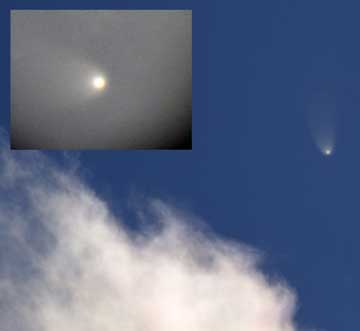
Comets grow bright when they're close to the Sun, basking in the intense solar radiation. Of course, they're also usually impossible to see against the overwhelming scattered sunlight. But surprising Comet McNaught - whose January 12 closest approach to the Sun (perihelion passage) was well inside the orbit of Mercury - gave an enjoyable performance in bright blue daytime skies. In fact, comet expert David Levy captured this remarkable inset (upper left) telescopic view of McNaught within an hour of perihelion, with the comet in broad daylight only about 7 degrees away from the Sun's position. Stefan Seip's wider daytime view of the comet and fluffy clouds was recorded approximately a day later. Seip used a polarizing filter and a telescope/camera set up near Stuttgart, Germany. No longer visible in broad daylight, Comet McNaught is now touring twilight southern skies.
Comet McNaught Over New Zealand NASA - January 18, 2007
After a remarkable performance in the northern hemisphere, the brightest comet in decades is now showing off in the south. Recorded during evening twilight on January 17, this view features the bright coma and gorgeous, sweeping tail of Comet McNaught (c/2006 P1) over Lake Horowhenua in Levin, a small town on New Zealand's North Island. Astronomer Noel Munford reports that the five second long digital camera exposure comes close to capturing the visual appearance of the comet in a sky colored by smoke from distant brush fires in Australia. Discovered last summer by R. H. McNaught (Siding Spring Survey), the comet grew impressively bright in early January and has even been sighted in full daylight. In the coming days Comet McNaught will continue to move south, for now a spectacle in southern skies as it heads for the outer solar system.
Comet McNaught from New STEREO Satellite NASA - January 16, 2007
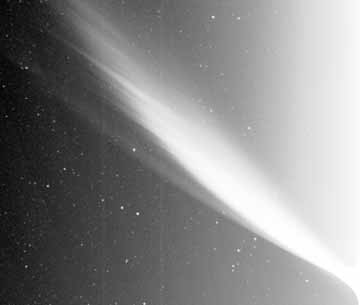
The brightest comet of recent decades was a surprising first sight for a new camera in space. The Sun Earth Connection Coronal and Heliospheric Investigation (SECCHI) instrument onboard the Solar TErrestrial RElations Observatory (STEREO) satellite had just opened up on January 11 when it snapped the above image of Comet McNaught. Visible was a spectacular view of the ion tail of Comet McNaught being swept away from the Sun by the solar wind in filamentary rays. The comet tail is seen to extend at least seven degrees across the above image, while the central coma is so bright it saturates. Comet McNaught is now reportedly so bright that it is visible even in broad daylight by blocking out the Sun with your hand. Comet McNaught has rounded the Sun and will slowly fade away for observers in Earth's Southern Hemisphere as it recedes from the Sun.
Comet McNaught NASA - January 15, 2007
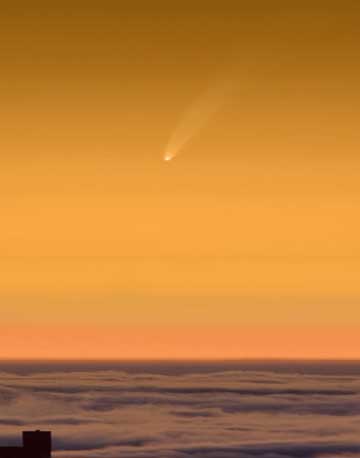
This past weekend Comet McNaught peaked at a brightness that surpassed even Venus. Fascinated sky enthusiasts in the Earth's northern hemisphere were treated to an instantly visible comet head and a faint elongated tail near sunrise and sunset. Recent brightness estimates had Comet McNaught brighter than magnitude -5 (minus five) over this past weekend, making it the brightest comet since Comet Ikeya-Seki in 1965, which was recorded at -7 (minus seven). The Great Comet of 2007 reached its brightest as it rounded the Sun well inside the orbit of Mercury. Over the next week Comet McNaught will begin to fade as it moves south and away from the Sun. The unexpectedly bright comet should remain visible to observers in the southern hemisphere with unaided eyes for the rest of January. The above image, vertically compressed, was taken at sunset last Friday from mountains above Catalonia, Spain.