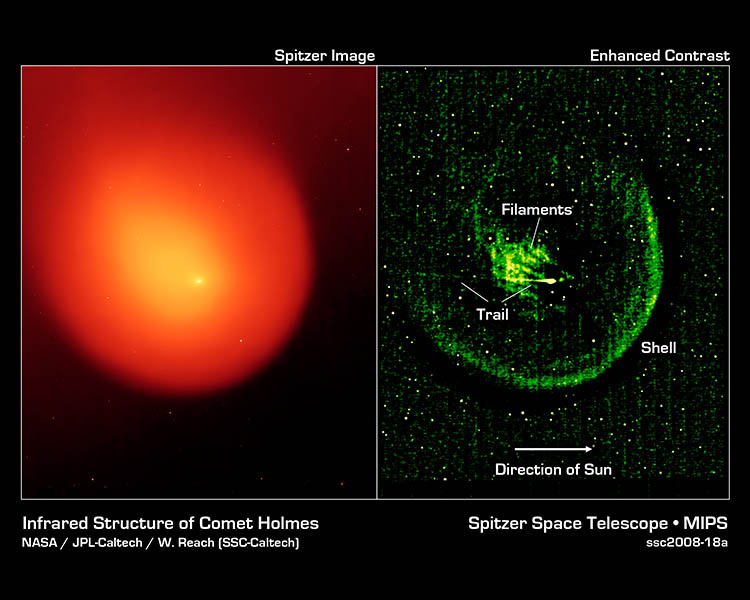
Comet Holmes (official designation: 17P/Holmes) is a periodic comet in the Solar System, discovered by the British amateur astronomer Edwin Holmes on November 6, 1892. Although normally a very faint object, Holmes became notable during its October 2007 return when it temporarily brightened by a factor of about half a million, in what was the largest known outburst by a comet, and became visible to the naked eye. It also briefly became the largest object in the solar system, as its coma (the thin dissipating dust ball around the comet) expanded to a diameter greater than that of the Sun (although its mass remained minuscule). Read More
Comet Holmes Image Gallery Spaceweather.com - November 2007
Expansive Comet Holmes NASA - November 21, 2007
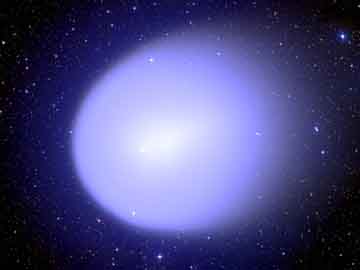
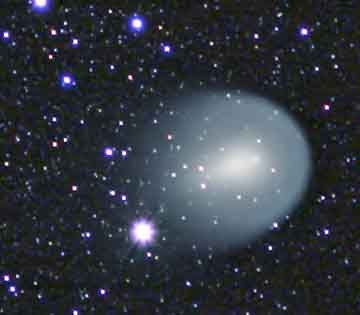
The spherical coma of Comet Holmes has swollen to a diameter of over 1.4 million kilometers, making the tenuous, dusty cloud even bigger than the Sun. Scattering sunlight, all that dust and gas came from the comet's remarkably active nucleus, whose diameter before the late October outburst was estimated to be a mere 3.4 kilometers. In this sharp image, recorded on November 14 with the Canada-France-Hawaii Telescope, stars are easily visible right through the outer coma, while the nucleus is buried inside the condensed, bright region. The bright region of the coma seems offset from the center, consistent with the idea that a large fragment drifted away from the nucleus and disintegrated, producing the comet's spectacular outburst. Of course, more recent images of Holmes also show the bright star Mirfak (Alpha Persei) shining through as the comet sweeps slowly through the constellation Perseus.
Incredible Comet Bigger than the Sun Space.com - November 17, 2007
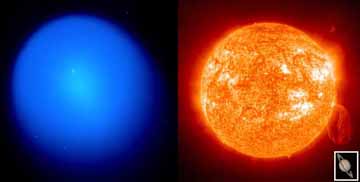
A comet that has delighted backyard astronomers in recent weeks after an unexpected eruption has now grown larger than the sun. The sun remains by far the most massive object in the solar system, with an extended influence of particles that reaches all the planets. But the comparatively tiny Comet Holmes has released so much gas and dust that its extended atmosphere, or coma, is larger than the diameter of the sun. The comparison is clear in a new image.
The Inner Coma of Comet Holmes NASA - November 13, 2007
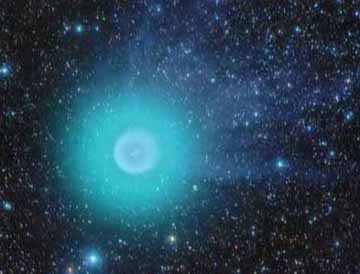
What's happening to Comet Holmes? The rare comet remains visible to the unaided eyes of northern observers as an unusual small puff ball in the constellation of Perseus. A high resolution set of images of the comet's inner coma, taken last week and shown above, reveals significant detail. Close inspection shows numerous faint streamers that are possibly the result of jets emanating from the comet's nucleus. Comet Holmes has remained surprisingly bright over the past week, with luminosity estimates ranging from between visual magnitudes 2 to 3, making it brighter than most stars visible on a dark sky. The above image of Comet Holmes was made with a small automated 0.38-meter telescope hirable over the web for a small fee.
A Tale of Comet Holmes NASA - November 10, 2007
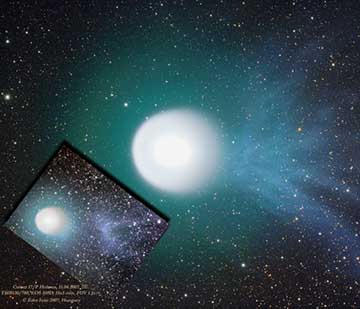
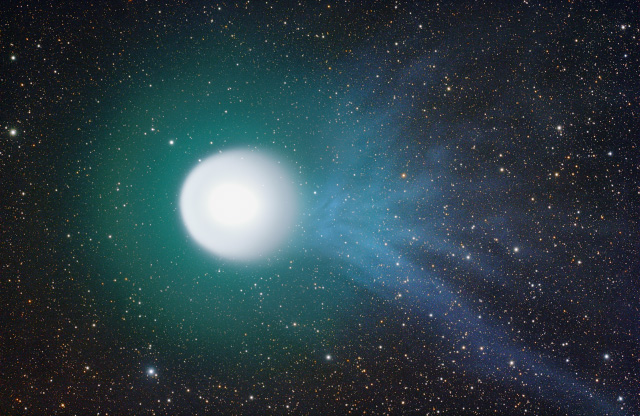
A beautiful blue ion tail has become visible in deep telescopic images of Comet Holmes. Pointing generally away from the Sun and also planet Earth, the comet's ion tail is seriously foreshortened by our extreme viewing angle. Still, enthusiastic comet watchers have remarked that on the whole, the compact but tentacled appearance suggests a jellyfish or even a cosmic calamari. This stunning view of the comet's greenish coma and blue tail was recorded on November 4 in clear skies near Budapest, Hungary. The colors are caused by molecules in the tenuous gas, like C2 (green) and CO+ (blue), fluorescing in sunlight. In a more recent development, the dramatic inset is a deep image from L'Aquila in central Italy on November 8, showing the ion tail disconnecting from the comet.
Skyscape with Comet Holmes NASA - November 9, 2007
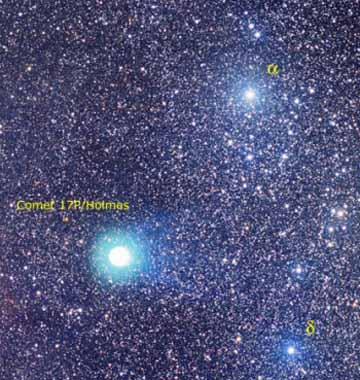
This gorgeous skyscape spans some 10 degrees across the heroic constellation Perseus, about the size of a generous binocular field of view. The deep exposure includes bright stars, emission nebulae, star clusters, and, of course, the famous Comet Holmes. To identify the celestial landmarks, just place your cursor over the image. The brightest star in view, Alpha Persei, is itself surrounded by a loose cluster of stars - the Alpha Per Moving Cluster - at a distance of about 600 light-years. But, at a distance of a mere 14 light-minutes bright Comet Holmes still dominates the scene with its fluorescing greenish coma and foreshortened blue tail.
Comet Holmes Grows a Tail NASA - November 5, 2007
Comet Holmes continues to be an impressive sight to the unaided eye. The comet has diminished in brightness only slightly, and now clearly appears to have a larger angular extent than stars and planets. Astrophotographers have also noted a distinctly green appearance to the comet's coma over the past week. Pictured above over Spain in three digitally combined exposures, Comet 17P/Holmes now clearly sports a tail. The blue ion tail is created by the solar wind impacting ions in the coma of Comet Holmes and pushing them away from the Sun. Comet Holmes underwent an unexpected and dramatic increase in brightness starting only two weeks ago. The detail visible in Comet Holmes' tail indicates that the explosion of dust and gas that created this dramatic brightness increase is in an ongoing and complex event. Comet Holmes will move only slightly on the sky over during the next month.
A Telescopic View of Erupting Comet Holmes NASA - October 28, 2007
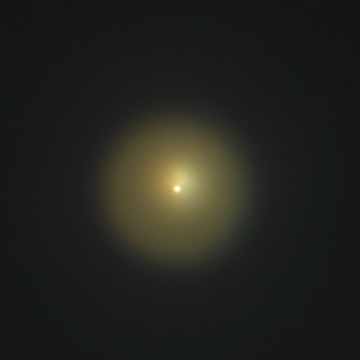
What's happened to Comet Holmes? A normally docile comet discovered over 100 years ago, Comet 17P/Holmes suddenly became nearly one million times brighter last week, possibly over just a few hours. In astronomical terms, the comet brightened from magnitude 17, only visible through a good telescope, to magnitude 3, becoming visible with the unaided eye. Comet Holmes had already passed its closest to the Sun in 2007 May outside the orbit of Mars and was heading back out near Jupiter's orbit when the outburst occurred. The comet's sudden brightening is likely due to some sort of sunlight-reflecting outgassing event, possibly related to ice melting over a gas-filled cavern, or possibly even a partial breakup of the comet's nucleus. Pictured above through a small telescope last Thursday, Comet Holmes appeared as a fuzzy yellow spot, significantly larger in angular size than Earth-atmosphere blurred distant stars. Although Comet Holmes' orbit will place it in northern hemisphere skies for the next two years, whether it will best be viewed through a telescope or sunglasses remains unknown.