67P/Churyumov-Gerasimenko (abbreviated 67P or 67P/C–G and nicknamed "Chury") is a Jupiter-family comet. It is originally from the Kuiper belt and has an orbital period of 6.45 years as of 2012, a rotation period of approximately 12.4 hours, and a maximum velocity of 135,000 km/h (38 km/s; 84,000 mph).
Churyumov–Gerasimenko is approximately 4.3 by 4.1 km (2.7 by 2.5 mi) at its longest and widest dimensions. It was first observed on photographic plates in 1969 by Soviet astronomers Klim Ivanovych Churyumov and Svetlana Ivanovna Gerasimenko, after whom it is named.It most recently came to perihelion (closest approach to the Sun) on November 2, 2021, and will next come to perihelion on April 9, 2028.
Churyumov–Gerasimenko was the destination of the European Space Agency's Rosetta mission, launched on 2 March 2, 2004. Rosetta rendezvoused with Churyumov–Gerasimenko on August 6, 2014 and entered orbit on September 10, 2014. Rosetta's lander, Philae, landed on the comet's surface on November 12, 2014, becoming the first spacecraft to land on a comet nucleus. On September 30, 2016 the Rosetta spacecraft ended its mission by landing on the comet in its Maʽat region. Read more ...
Rosetta's 'rubber ducky' comet has ultraviolet auroras Live Science -September 26, 2020
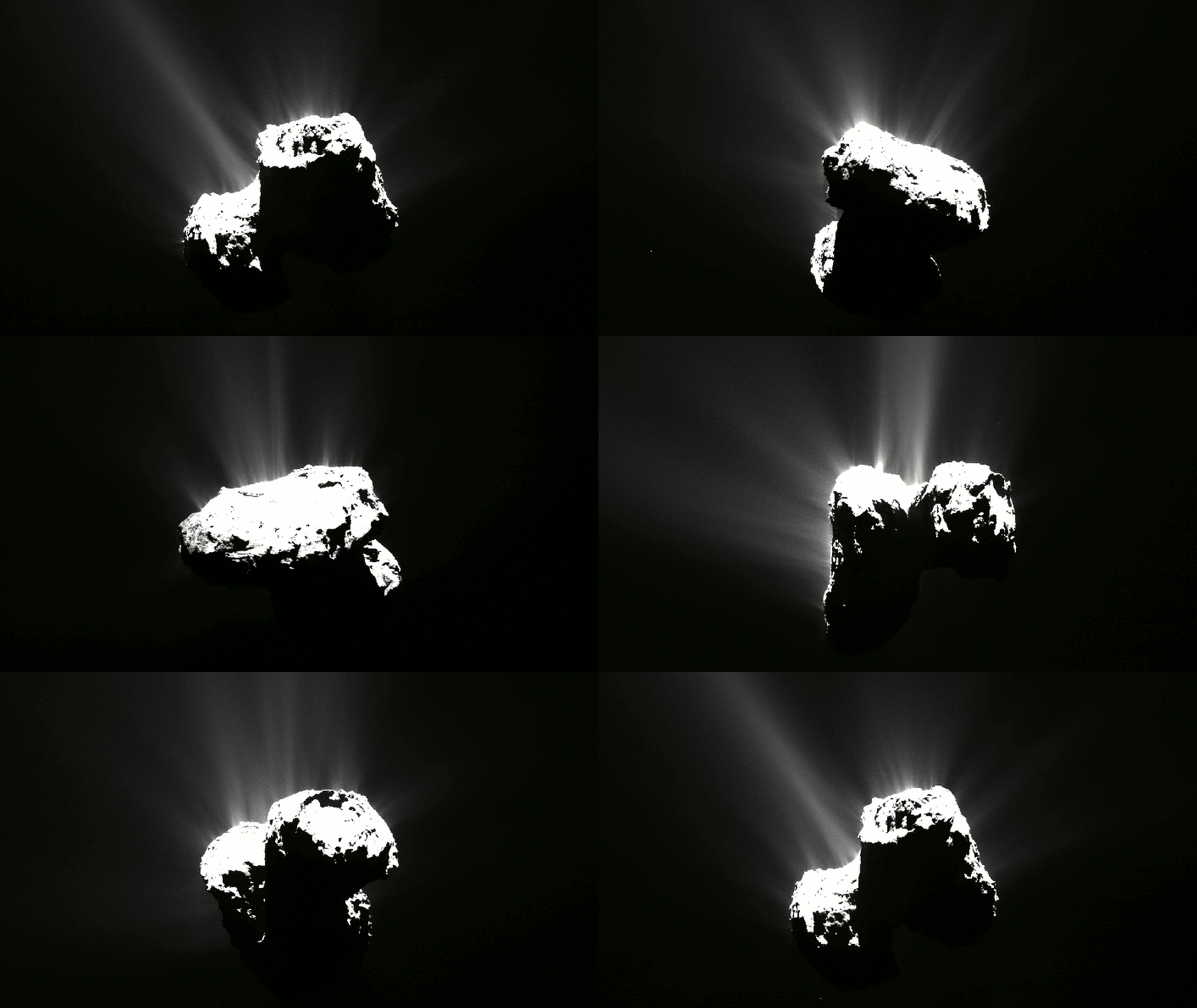
While looking at data from Rosetta, researchers found evidence of ultraviolet auroras at Comet 67P/Churyumov-Gerasimenko, which the probe studied up close for nearly two years before the mission ended in 2016.
Comet discovered to have its own northern lights Science Alert -September 21, 2020
Comet 67P/Churyumov-Gerasimenko has its own far-ultraviolet aurora, data reveal. It is the first time such electromagnetic emissions in the far-ultraviolet have been documented on a celestial object other than a planet or moon.
Rosetta mission ends in comet collision BBC - September 30, 2016
Europe's Rosetta probe has ended its mission to Comet 67P by crash-landing on to the icy object's surface. Mission control in Darmstadt, Germany, was able to confirm the impact had occurred when radio contact to the aging spacecraft was lost abruptly. The assumption is that the probe would have been damaged beyond use.
Farewell Philae: Earth severs link with silent comet probe PhysOrg - July 27, 2016
Earth bid a final farewell to robot lab Philae on Wednesday, severing communications after a year-long silence from the pioneering probe hurtling through space on a comet. Philae sent home reams of data garnered from sniffing, tasting and prodding its new alien home hundreds of millions of kilometres (miles) from Earth.
Space agency releases first picture from comet PhysOrg - November 13, 2014
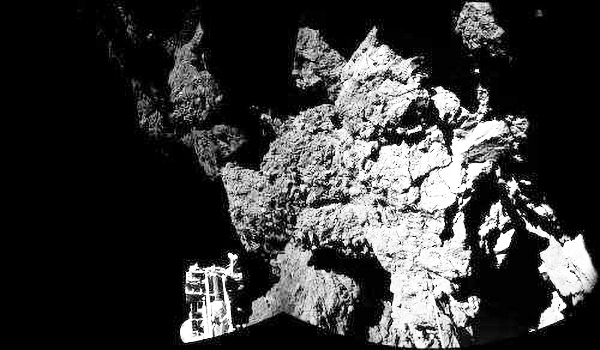
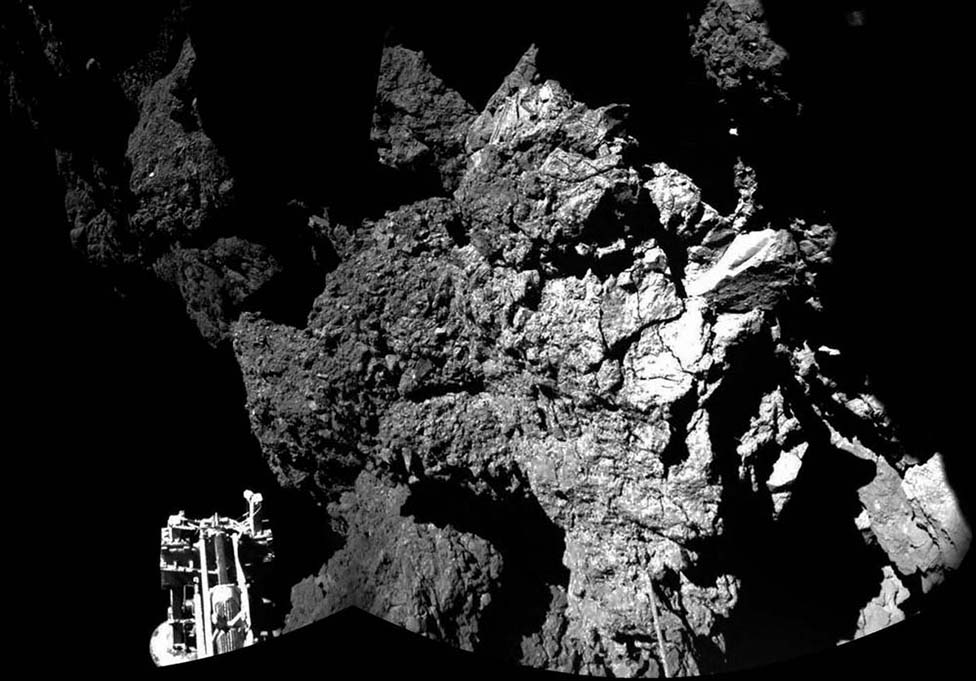
The European Space Agency on Thursday published the first image taken from the surface of a comet, and said that its Philae lander is still "stable" despite a failure to latch on properly to the rocky terrain. The lander scored a historic first Wednesday, touching down on comet 67P/Churyumov-Gerasimenko after a decade-long, 6.4 billion-kilometer (4 billion-mile) journey through space aboard its mother ship Rosetta. Scientists' jubilation was slightly dampened because the harpoons which were meant to anchor the lander to the surface failed to deploy, causing it to bounce twice before it came to rest on the comet's 4 kilometer-wide body, or nucleus. "Philae is stable, sitting on the nucleus and is producing data," Gerhard Schwehm, a scientist on the Rosetta mission, told The Associated Press. "The lander is very healthy."
Perihelion Approaches NASA - August 15, 2015
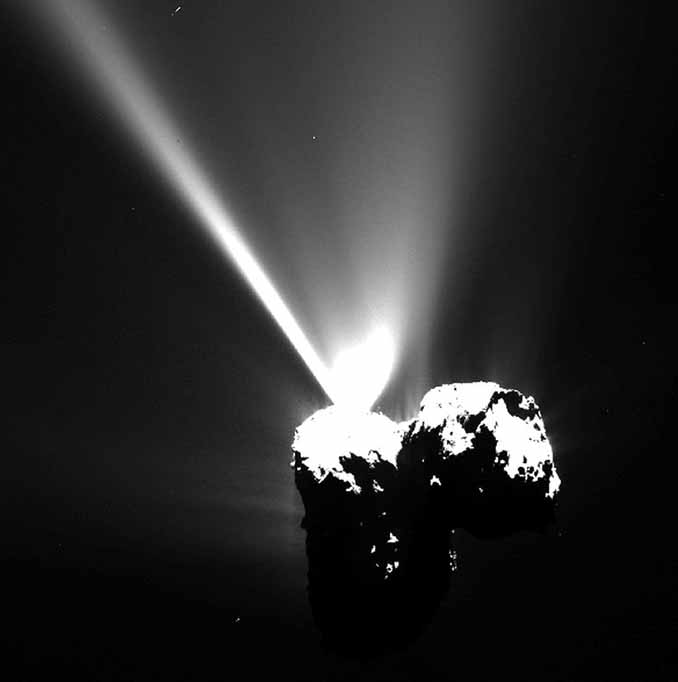
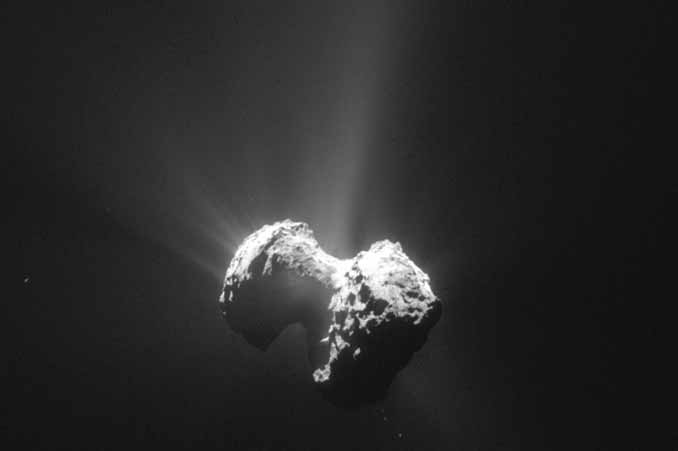
This dramatic outburst from the nucleus of Comet 67P/Churyumov-Gerasimenko occurred on August 12, just hours before perihelion, its closest approach to the Sun. Completing an orbit of the Sun once every 6.45 years, perihelion distance for this periodic comet is about 1.3 astronomical units (AU), still outside the orbit of planet Earth (at 1 AU). The stark image of the 4 kilometer wide, double-lobed nucleus in bright sunlight and dark shadows was taken by the Rosetta spacecraft's science camera about 325 kilometers away.
Too close to see the comet's growing tail, Rosetta maintains its ringside seat to watch the nucleus warm and become more active in coming weeks, as primordial ices sublimating from the surface produce jets of gas and dust. Of course, dust from the nucleus of periodic comet Swift-Tuttle, whose last perihelion passage was in 1992 at a distance of 0.96 AU, fell to Earth just this week.
Philae Probe Finds Evidence That Comets Can Be Cosmic Labs Epoch Times - July 31, 2015
Comets are loaded with all the raw materials like water, CO2, methane, ammonia, needed to assemble more complex organic molecules, perhaps sparked by UV-photons from the Sun or cosmic rays, or in the shock that occurs when a comet hits the surface of a planet like the young Earth.
Philae comet lander wakes up BBC - June 14, 2015
Philae, the first spacecraft to land on a comet, was dropped on to the surface of Comet 67P by its mothership, Rosetta, last November. It worked for 60 hours before its solar-powered battery ran flat.
Rosetta Pours Cold Water on Cometary Origins of Earth's Oceans Scientific American - December 10, 2014
In the Enuma Elish, a Babylonian epic that recounts the creation of the world, the heavens and the Earth emerge from a primordial abyss of brackish water. According to the biblical book of Genesis, water existed before land, life, and even light itself. Our ancient ancestors realized, just as we do today, that water is fundamental to life. But even though they could conceive creation stories for the Earth, moon, and stars, many cultures at the dawn of recorded history seemed baffled by the origin of our planet's water. Thousands of years later, the genesis of Earth's oceans remains one of the key missing pieces in our modern creation stories.
Mystery of where Earth's water came from deepens PhysOrg - December 10, 2014
The mystery of where Earth's water came from got murkier Wednesday when some astronomers essentially eliminated one of the chief suspects: comets. Over the past few months, the European Space Agency's Rosetta space probe closely examined the type of comet that some scientists theorized could have brought water to our planet 4 billion years ago. It found water, but the wrong kind.
Comet landing: Organic molecules detected by Philae BBC - November 19, 2014
The Philae lander has detected organic molecules on the surface of its comet, scientists have confirmed. Carbon-containing "organics" are the basis of life on Earth and may give clues to chemical ingredients delivered to our planet early in its history. The compounds were picked up by a German-built instrument designed to "sniff" the comet's thin atmosphere. Other analyses suggest the comet's surface is largely water-ice covered with a thin dust layer.
Camera sees Philae's bouncy landing BBC - November 18, 2014
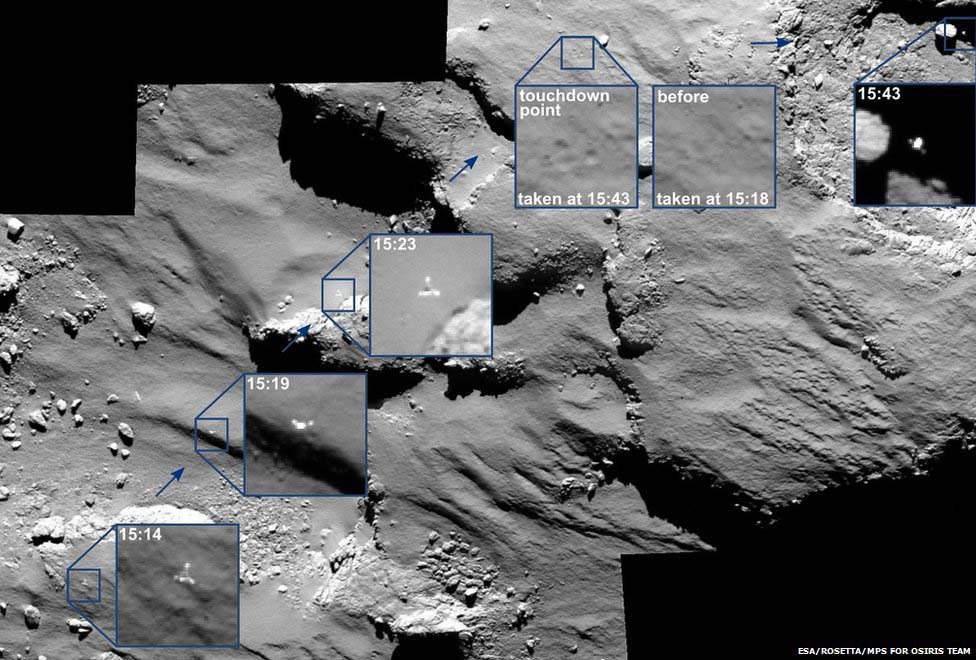
High-resolution pictures have now been released of the Philae probe in the act of landing on Comet 67P last Wednesday. They were acquired by the Narrow Angle Camera on the Rosetta satellite, which had dropped the little robot towards the surface of the "ice mountain". The images are presented as a mosaic covering the half-hour or so around the "first touchdown" - the probe then bounced to a stop about 1km away. Philae lost battery power on Saturday and is no longer talking with Earth. Scientists still have not located the craft's current resting spot.