Hellenistic Persia (330 BC-170 BC)

The later years of the Achaemenid dynasty were marked by decay and decadence. The mightiest empire in the world collapsed in only eight years, when it fell under the attack of a young Macedonian king, Alexander the Great.

Alexander the Great, King of Macedonia

Alexander was born in Macedon, a province of ancient Greece, in 356 B.C. He seemed destined at a young age for power. He assumed the throne of Macedon at the young age of twenty. At the age of twenty-two he attacked and conquered the Greek-occupied portion of the Achaemenid Empire, unifying the territories and becoming the great king of Greece. He then peacefully acquired most of Egypt and was made a pharaoh, which to the Egyptians meant he was the son of a god, therefore like a god himself.

Persia's weakness was exposed to the Greeks in 401 BC, when the Satrap of Sardis hired ten thousand Greek mercenaries to help secure his claim to the imperial throne. This exposed both the political instability and the military weakness of late Achaemenid Persia.

Philip II of Macedon, leader of most of Greece, and his son Alexander the Great decided to take advantage of this weakness. After Philip's death, Alexander set his sights on Persia, possibly for reasons of protection for Greece but mainly just for conquest.

Any doubts Alexander might have had about the success of his Persian campaign were put to rest when he consulted the Oracle at Delphi, who told him, "Thou art invincible, my son."

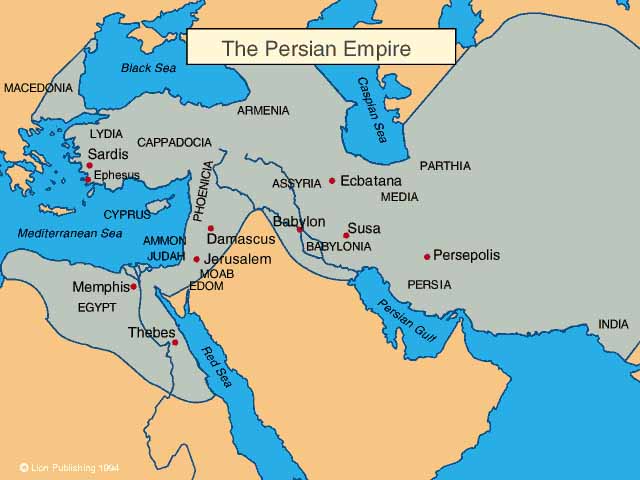
Alexander's army landed in Asia Minor in 334 BC. His armies quickly swept through Lydia, Phoenicia, and Egypt, before defeating all the troops of Darius III at Issus and capturing the capital at Susa.

The last Achaemenid resistance was at the "Persian Gates" near the royal palace at Persepolis. The Persian Empire was now in Greek hands.

Along the way he exercised such faculties as sharp intellect, discernment, knowledge of warfare and politics, and human nature. He treated his generals well and commanded their respect.

However in spite of being admired for his generosity, mastery, and loyalty, he was feared for his terrible temper. He once caught a traitorous lieutenant and cut off his ears and nose before killing him. He even slew one of his most capable generals and a loyal friends, Cleitus, over a drunken misunderstanding.

Alexander rapidly conquered Persia and declared himself the lord of Asia. He adopted a policy of fusion between his own kingdom of Greece and the vanquished Persia. He left the previous Persian rulers in control whenever possible.

Along his route of conquest, Alexander founded many colony cities, all named "Alexandria". For the next several centuries, these cities served to greatly extend Greek, or Hellenistic, culture in Persia.

He encouraged the flow of ideas, customs, and even preferred a Persian style of dress, and took a Persian wife Roxanne. Alexander's conquests, in addition to bringing him great fame and untold riches.

The historian Callisthenes began a rumor asserting that Alexander was the son of Zeus, significantly contributed and enriched Greek and Western culture in the areas of thought, science generally and specifically founded at least sixeteen cities, created new coinage, and pioneered methods for ruling and administrating government.

Alexander's next and final conquest would be what is now known as India. He began in 327 B.C. and eventually acquired a significant portion. Alexander dreamed of continuing eastward where he hoped to find a great eastern ocean. But facing a minor political disturbance at home, he returned to Greece in 324 B.C. and died in 323 B.C. of fever due to exhaustion and wounds recieved in previous battles, leaving his dream unfulfilled. He was thirty-two years old and had ruled for twelve years and eight months.

Alexander had succeeded, as Columbus did much later, in opening up a new world for western culture. Alexander amassed a territory from Greece to the Caspian sea. He was unquestionably the strongest power that the world at that point had ever seen. He seemed to be able to do just as he wished. He was one part realist and one part visionary and excelled at making war.

Alexander's empire broke up shortly after his death, but Persia remained in Greek hands. Alexander's general, Seleucus, took control of Persia, Mesopotamia, and later Syria and Asia Minor.

Greek colonization continued until around 250 BC; Greek language, philosophy, and art came with the colonists. Throughout Alexander's former empire, Greek became the common tongue of diplomacy and literature.

Trade with China had begun in Achaemenid times along the so-called Silk Road; but during the Hellenistic period it began in earnest. The overland trade brought about some fascinating cultural exchanges.

Buddhism came in from India, while Zoroastrianism traveled west to influence Judaism. Incredible statues of the Buddha in classical Greek styles have been found in Persia and Afghanistan, illustrating the mix of cultures that occurred around this time, although it is possible that Greco-Buddhist art dates from Achaemenid times when Greek artists worked for the Persians.

The Seleucid kingdom began to decline rather quickly. Even during Seleucus' lifetime, the capital was moved from Seleucia in Mesopotamia to the more Mediterranean-oriented Antioch in Syria.

The eastern provinces of Bactria and Parthia broke off from the Seleucid Kingdom in 238 BC.

King Antiochus III's military leadership kept Parthia from overrunning Persia itself, but his successes alarmed the burgeoning Roman Empire. Roman legions began to attack the kingdom.

At the same time, the Seleucids had to contend with the revolt of the Maccabees in Judea and the expansion of the Kushan Empire to the east.

The empire fell apart and was conquered by Parthia and Rome.


Parthian Persia (170 BC-AD 226)


Metallic statue of a Parthian prince (thought to be Surena), AD 100,
kept at The National Museum of Iran, Tehran.

Parthia was a region north of Persia in what is today northeastern Iran. Its rulers, the Arsacid dynasty, belonged to an Iranian tribe that had settled there during the time of Alexander. They declared their independence from the Seleucids in 238 BC, but their attempts to expand into Persia were thwarted until c. 170 BC under Mithridates I.

The Parthian Empire shared a border with Rome along the upper Euphrates River. The two empires became major rivals. Parthian mounted archers proved a match for Roman legions, as in the Battle of Carrhae in which the Parthian General Surena defeated Crassus of Rome. Wars were very frequent, with Mesopotamia serving as the battleground.

During the Parthian period, Hellenistic customs partially gave way to a resurgence of Persian culture. However, the empire lacked political unity. By the first century BC, Parthia was decentralized, ruled by feudal nobles.

Wars with Rome to the west and the Kushan Empire to the northeast drained the country's resources.

Parthia, now impoverished and without any hope to recover the lost territories, was demoralized. The kings had to give more concessions to the nobility, and the vassal kings sometimes refused to obey.

In AD 224, the Persian vassal king Ardashir revolted. Two years later, he took Ctesiphon, and this time, it meant the end of Parthia. It also meant the beginning of the second Persian Empire, ruled by the Sassanid kings.


Sassanid Persia (AD 226-650)


Head of king Shapur II (Sasanian dynasty 4th century AD).

During Parthian rule, Persia was only one province in a large, loosely controlled empire. The local king of Persia at this time, Ardashir I, led a revolt against the imperial government of Parthia. In two years he was the shah of a new Persian Empire.

The Sassanid (or Sassanian) dynasty (named for Ardashir's grandfather) was the first native Persian ruling dynasty since the Achaemenids; thus they saw themselves as the successors of Darius and Cyrus. They pursued an aggressive expansionist policy. They recovered much of the eastern lands that the Kushans had taken in the Parthian period. The Sassanids continued to make war against Rome; a Persian army even captured the Emperor Valerian in 260.

Sassanid Persia, unlike Parthia, was a highly centralized state. The people were rigidly organized into a caste system: Priests, Soldiers, Scribes, and Commoners. Zoroastrianism was finally made the official state religion, and spread outside Persia proper and out into the provinces. There was sporadic persecution of other religions. The Catholic (Orthodox) Christian church was particularly persecuted, but this was in part due to its ties to the Roman Empire. The Nestorian Christian church was tolerated and sometimes even favored by the Sassanids.

The wars and religious control that had fueled Sassanid Persia's early successes eventually contributed to its decline. The eastern regions were conquered by the White Huns in the late 400s. Adherents of a radical religious sect, the Mazdakites, revolted around the same time. Khosrau I was able to recover his empire and expand into the Christian countries of Antioch and Yemen. Between 605 and 629, Sassanids successfully annexed Levant and Egypt and pushed into Anatolia.

However, a subsequent war with the Romans utterly destroyed the empire. In the course of the protracted conflict, Sassinid armies reached Constantinople, but could not defeat the Byzantines there. Meanwhile, the Byzantine Emperor Heraclius had successfully outflanked the Persian armies in Asia Minor and handed them a crushing defeat in Northern Mesopotamia. The Sassanids had to give up all their conquered lands and retreat. This defeat was mentioned in Qur'an as a "victory for believers," referring to the Romans, who were monotheists, in contrast to the pagan Sassinids.

Heavy taxes caused by the very long war caused rebellions across the empire, and the Emperor Khosro II (Parviz) was assassinated in 629. This incident was allegedly fortold by Muhammed as a punishment from God because Khosro humiliated Muhammed's messangers and tore a message from the Prophet which contained a chapter of Qur'an. After a defeat at Nineveh in 642, Khosro's successor Kavdah II was also assassinated. Civil war broke out across the Empire and the country descended into anarchy.


Islam and Persia (650-1219)

The explosive growth of the Arab Caliphate coincided with the chaos caused by the end of Sassanid rule. Conquest came easily; most of the country was overrun in 643-650. The last resistance from the remnants of the Sassanid dynasty ended two years later.

Persia's conquest by Islamic Arab armies marks the transition into "medieval" Persia.

Yazdagird III, the last Sasanian King, died ten years after he lost his empire to the newly-formed Muslim Caliphate. He tried to recover some of what he lost with the help of the Turks and the Tatars but they were easily defeated by Muslim armies. Then he seeked the aid of the Chinese but they refused to help him. He is believed to have lived on the borders of the Islamic Persia. Some historians say that he lived inside the Islamic Persia.

The Arab empire, ruled by the Umayyad Dynasty, was the largest state in history up to that point. It stretched from Spain to the Indus, from the Aral Sea to the southern tip of Arabia. Yet the Umayyads borrowed heavily from Persian and Byzantine administrative systems and moved their capital to Damascus, in the center of their empire. The Umayyads would rule Persia for a hundred years.

The Arab conquest dramatically changed life in Persia. Arabic became the new lingua franca and Islam quickly replaced Zoroastrianism; mosques were built, and many Persians intermarried with Arabs. A new language, religion, and culture were added to the Persian cultural milieu.

In 750 the Umayyads were ousted from power by the Abbasid family. By that time, Iranians had come to dominate not only the bureacracy of the empire, but all branches of the government. The unrivaled dominance of the Persians on all affairs of the administration of the Caliphate led to the spread and blossoming of Persian culture, science, mathematics, and medicine, throughout the Arab world.

The caliph Al-Ma'mun, whose mother was an Iranian, moved his capital away from Arab lands into Merv in eastern Persia. It was he who later founded the Baghdad House of Wisdom, based on the Persian Jondishapour.

The scientific movement that resulted from this was to have a direct impact on the European Renaissance centuries later: the Iranian Khwarazmi contributed heavily to the mathematical field of algebra, earning himself the title of Father of Algebra. He, along with hundreds of other prominent scholars, carried the torch of the world's most advanced civilizations for hundreds of years.

But political unrest continued. In 819, East-Persia was conquered by the Persian Samanids, the first native rulers after the Arabic conquest. They made Samarqand, Bukhara and Herat their capitals and revived the Persian language and culture.

It was approximately during this age, when the poet Firdawsi finished the Shah Nama, an epic poem retelling the history of the Persian kings; Firdawsi completing the poem in 1008.In 913, West-Persia was conquered by the Buwayhid, a native Persian tribal confederation from the shores of the Caspian Sea.

They made the Persian city of Shiraz their capital. The Buwayids destroyed Islam's former territorial unity. Rather than a province of a united Muslim empire, Persia became one nation in an increasingly diverse and cultured Islamic world.

The Muslim world was shaken again in 1037 with the invasion of the Seljuk Turks from the northeast. The Seljuks created a very large Middle Eastern empire and continued in the flowering of medieval Islamic culture.

The Seljuks built the fabulous Friday Mosque in the city of Isfahan.

The most famous Persian writer of all time, Omar Khayyam, wrote his Rubayat of love poetry during Seljuk times.

In the early 1200s the Seljuks lost control of Persia to another group of Turks from Khwarezmia, near the Aral Sea. The shahs of the Khwarezmid Empire ruled for only a short while, however, because they had to face the most feared conqueror in history: Genghis Khan.


Persia under the Mongols and their successors (1219-1500)

In 1218, Genghis Khan sent ambassadors and merchants to the city of Otrar, on the northeastern confines of the Khwarizm shahdom. The governor of Otrar had these envoys executed. Genghis, out of revenge, sacked Otrar in 1219 and continued on to Samarkand and other cities of the northeast.

Genghis' grandson, Hulagu Khan, finished what Genghis had begun when he conquered Persia, Baghdad, and much of the rest of the Middle East in 1255-1258. Persia became the Ilkhanate, a division of the vast Mongol Empire.

In 1295, after Ilkhan Ghazan converted to Islam, he renounced all allegiance to the Great Khan. The Ilkhans patronized the arts and learning in the fine tradition of Persian Islam; indeed, they helped to repair much of the damage of the Mongol conquests.

In 1335, the last Ilkhan's death spelled the end of the Ilkhanate. It splintered into a number of small states. This left Persia open to still more conquest at the hands of another conqueror connected with the Mongol Empire: Timur the Lame or Tamerlane. He invaded Persia beginning around 1370 and plundered the country until his death in 1405.

Timur was an even bloodier conqueror than Genghis had been. In Isfahan, for instance, he slaughtered 70,000 people so that he could build towers with their skulls. He conquered a wide area and made his own city of Samarkand rich, but he made no effort to forge a lasting empire. Persia was essentially left in ruins.

For the next hundred years Persia was not a unified state. It was ruled for a while by descendants of Timur, called the Timurid emirs. Toward the end of the 1400s, Persia was taken over by the Emirate of the White Sheep Turkmen (Ak Koyunlu). But there was little unity and none of the sophistication that had defined Persia during the glory days of Islam.


A New Persian Empire: The Safavids (1500-1722)

The Safavid Dynasty hailed from Azerbaijan, at that time considered a part of the greater Persia region. The Safavid Shah Ismail I overthrew the White Sheep Turkish rulers of Persia to found a new native Persian empire. Ismail expanded Persia to include all of present-day Azerbaijan, Iran, and Iraq, plus much of Afghanistan.

Ismail's expansion was halted by the Ottoman Empire at the Battle of Chaldiran in 1514, and war with the Ottomans became a fact of life in Safavid Persia.

Safavid Persia was a violent and chaotic state for the next seventy years, but in 1588 Shah Abbas the Great ascended to the throne and instituted a cultural and political renaissance.

He moved his capital to Isfahan, which quickly became one of the most important cultural centers in the Islamic world. He made peace with the Ottomans. He reformed the army, drove the Uzbeks out of Persia and into modern-day Uzbekistan, and captured a Portuguese base on the island of Ormus.

The Safavids were followers of Shi'a Islam, and under them Persia became the largest Shi'ite country in the Muslim world, a position Iran still holds today.

Under the Safavids Persia enjoyed its last period as a major imperial power. In the early 1600s, a final border was agreed upon with Ottoman Turkey; it still forms the border between Turkey and Iran today.


Persia and Europe (1722-1914)

In 1722, Safavid Persia collapsed. That year saw the first European invasion of Persia since the time of Alexander: Peter the Great, Czar of Russia, invaded from the northwest as part of a bid to dominate central Asia. To make the situation truly hopeless, Ottoman forces accompanied the Russians, successfully laying siege to Isfahan.

The country was able to weather the invasions; neither the Russians nor the Turks gained any territory. However, the Safavids were severely weakened, and that same year (1722), the empire's Afghani subjects launched a bloody revolt in response to the Safavids' attempts to convert them from Sunni to Shi'a Islam by force. The last Safavid shah was executed, and the dynasty came to an end.

Throughout the Middle Ages, the natural philosophy and mathematics of ancient Greeks were furthered and preserved within the Muslim world. During this period, Persia became a centre for the manufacture of scientific instruments, retaining its reputation for quality well into the 19th century.

The Persian empire experienced a temporary revival under Nadir Shah in the 1730s and '40s. Nadir drove out the Russians and confined the Afghans to their present home in Afghanistan. He launched many successful campaigns against Persia's old enemies, the nomadic khanates of Central Asia; most of them were destroyed or absorbed into Persia. However, his empire declined after his death. His rule was followed by the weak and short-lived Zand dynasty. Persia was left unprepared for the worldwide expansion of European empires in the eighteenth and nineteenth centuries.

Persia found relative stability in the Qajar dynasty, ruling from 1779 to 1925, but lost hope to compete with the new industrial powers of Europe; Persia found itself sandwiched between the growing Russian Empire in Central Asia and the expanding British Empire in India. Each carved out pieces from Persia that became Bahrain, Azerbaijan, Kyrgyzstan, Turkmenia, Tajikestan, Uzbekistan, and parts of Afghanistan.

Although Persia was never directly invaded, it gradually became economically dependent on Europe. The Anglo-Russian Convention of 1907 formalised Russian and British spheres of influence over the north and south of the country, respectively, where Britain and Russia each created a "sphere of influence", where the colonial power had the final "say" on economic matters.At the same time the young Shah had granted a concession to William Knox D'Arcy, later the Anglo-Persian Oil Company, to explore and work the newly-discovered oil fields at Masjid-al-Salaman in southwest Persia, which started production in 1914. Winston Churchill, as First Sea Lord to the British Admiralty, oversaw the conversion of the Royal Navy to oil-fired battleships and partially nationalized it prior to the start of war. A small Anglo-Persian force was garrisoned there to protect the field from some hostile tribal factions.


Persia in World War One (1914-1918)

Persia was drawn into the periphery of WWI because of its strategic position between Afghanistan and the warring Ottoman, Russian, and British Empires. In 1914 Britain sent a military force to Mesopotamia to deny access to the Persian oilfields from the Ottomans. Germany retaliated on behalf of its ally by spreading a rumour that the Kaiser had converted to Islam, and sent agents through Persia to attack the oil fields and raise a Jihad against British rule in India. Most of those German agents were captured by Persian, British and Russian troops who were sent to patrol the Afghan border, and the rebellion faded away.

This was followed by a German attempt to abduct and control the young Shah, with the assistance of his mainly-Swedish bodyguard, which was foiled at the last moment.

In 1916 the fighting between Russian and Ottoman forces to the north of the country had spilt down into Persia; Russia gained the advantage until most of her armies collapsed in the wake of the 1917 Russian Revolution.

This left the Caucasus unprotected, and the Caucasian and Persian civilians starving after years of war and depravation. In 1918 a small force of 400 British troops under General Dunsterville moved into the Trans-Caucasus from Persia in a bid to encourage local resistance to German and Ottoman armies who were about to invade the Baku oilfields.

Although they later withdrew back into Persia, they did succeed in delaying the Turks access to the oil almost until the Armistice. In addition, the expeditionıs supplies were used to avert a major famine in the region, and a camp for 30,000 displaced refugees was created near the Persian-Mesopotamian border.

Persia after World War One (1919-1935)

By WW1 Persia was not the world power it had once been; it had become a tool in the political battles of other empires.In 1919 northern Persia was occupied by the British General Edmund Ironside to enforce the Turkish Armistice conditions and assist General Malleson contain Boshevik influences in the north. Britain also took tighter control over the increasingly lucrative oilfields.

In 1925, Reza Shah Pahlavi seized power from the Qajars and established the new Pahlavi dynasty. However, Britain and the Soviet Union remained the influential powers in Persia into the early years of the Cold War.The second-to-last Shah, Reza Pahlavi, asked the world to call the country Iran in 1935, but in 1959 Mohammad Reza Pahlavi announced that both Persia and Iran can be used interchangeably.


References and Links:

Persian Empire Wikipedia

Greco-Persian Wars

List of Persian Kings

Iran - Persia


In the News ...


The ancient girl with the golden eye: 5,000 year old priestess found

Cylindrical Seal with a Strange Design Discovered in Dezful CHN - May 31, 2006

4 Winged Goddesses Flew over Iran

Cultural Heritage News Agency - October 13, 2005