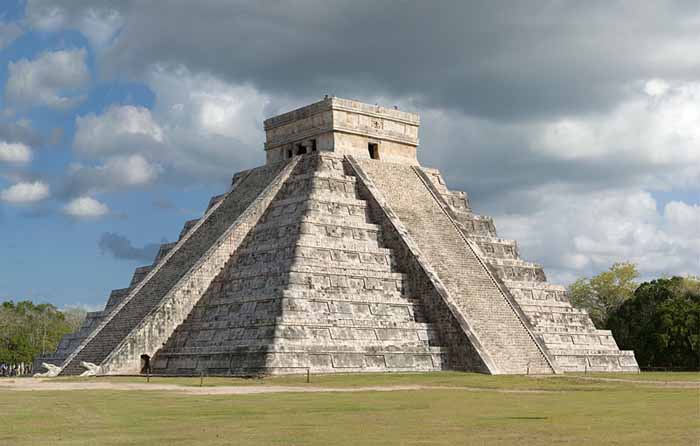
Chichen Itza is a large pre-Columbian archaeological site in Yucatan, Mexico built by the Maya civilization. The Maya name "Chich'en Itza" means "At the mouth of the well of the Itza (people)". Although this was the usual name for the site in pre-Columbian times, it is also referred to in the ancient chronicles as Uucyabnal, meaning "Seven Great Rulers". Chichen" contains many fine stone buildings in various states of preservation; the buildings were formerly used as temples, palaces, stages, markets, baths, and ballcourts.


Mayan Pyramid of Kukulkan
Dominating the center of Chichen is the Temple of Kukulcan (the Maya name for Quetzalcoatl), often referred to as El Castillo (the castle). This step pyramid with a ground plan of square terraces with stairways up each of the 4 sides to the temple on top.

Great sculptures of Plumed Serpents run down the sides of the northern staircase, and are set off by shadows from the corner tiers on the Spring and Fall equinox. It was practice in Mesoamerican cities to periodically build larger and grander temple pyramids atop older ones, and this is one such example.
Thanks to archeologists, a doorway at the base of the north stairway leads to a tunnel, from which one can climb the steps of the earlier version of El Castillo inside the current one, up to the room on the top where you can see King Kukulcan's Jaguar Throne, carved of stone and painted red with jade spots.

Built into one of the exterior walls of the ballcourt is the Temple of the Jaguar, which features another jaguar throne since this one was not buried for a thousand years, its red paint and jade spots are long since gone. Behind this platform is a walled inscription which depicts a tzompantli (rack of impaled human skulls) in relief.

The 'Temple of the Warriors' and its adjacent 'Temple of the Jaguar' are very impressive ruins of the complex. A massive temple structure, surrounded by hundreds of columns is carved with reliefs. The columns continue on into the jungle, that part of the temple still has not been restored.

This celestial observatory denotes seasons based on solar alignment at different times of the year.
The Nunnery

The Mayans were great sportsmen and build huge ballcourts to play their games. The Great Ballcourt of Chichén Itzá is 545 feet long and 225 feet wide overall. It has no vault, no discontinuity between the walls and is totally open to the sky. As we approach a silent sentinel stands guard.

Each end has a raised "temple" area. A whisper from end can be heard clearly at the other end 500 feet away and through the length and breath of the court. The sound waves are unaffected by wind direction or time of day/night. Archaeologists engaged in the reconstruction noted that the sound transmission became stronger and clearer as they proceeded. In 1931 Leopold Stokowski spent 4 days at the site to determine the acoustic principals that could be applied to an open-air concert theater he was designing. Stokowski failed to learn the secret. To this day it has not been explained.
The massive Kukulcan pyramid called 'El Castillo' - the castle - is roughly at the center of the site. Climbing it is quite a challenge and those who make it are rewarded with a spectacular view of the city and surrounding country side. Inside the pyramid, the corridors and chambers are hot and humid.

Handclaps evoke chirped echoes from the staircases of the Pyramid of Kukulkan at Chichen Itza. The physics of the chirped echo can be explained quite simply as periodic reflections from stepfaces. The chirped echo sounds much like the primary call of the Mayan sacred bird, the resplendent Quetzal.

This magnificent bird, now near extinction, has for thousands of years represented the 'spirit of the Maya'. Spirits, in many traditions, speak in echoes, lacking a body, just pure spirit.
A Mayan glyph from the Dresden Codex makes the connection between the pyramid of Kukulkan and the Quetzal bird. This glyph shows Kukulkan/Quetzalcoatl , the "sovereign plumed serpent" with a gigantic Quetzal behind him. The Quetzal bird may have represened the spirit of the Maya. Spirits often speak in echoes. It therefore seems most appropriate that the spirit echo of the Pyramid of Kukulkan would speak in the echo-voice of the Quetzal.
Today the Quetzal plays an important part in modern Mayan culture. Many modern Maya live in Guatemala, and in the Mexican States of Chiapas and Quintan Roo. The Quetzal is the unit of currency in Guatemala. The Guatemalan government issues a prestigious award named "The Order of the Quetzal." Could the Maya have intentionally coded the sound of their sacred bird into the pyramid architecture?
In the millenium since this pyramid was built, though the plaster has eroded from the limestone staircases, the sound is still recognizable.


Tzintzuntzan is a city in the state of Michoacan, Mexico. It stands on the eastern shore of Lake Pátzcuaro, about 15 km north of the city of Patzcuaro and about 60 km west of state capital Morelia, and at some 2050 m above sea level. It serves as the administrative seat for the surrounding municipality of the same name and, in the 2000 census, reported a population of 3,610 people.
The city was founded in the 13th century by the Native American Tarascan or Purepecha nation, in whose language the name means "Place of the Hummingbirds".
In the last years of the 15th century it became the capital of the Tarascan league, replacing nearby Ihuatzio. During this time the Purepecha successfully repulsed an invasion by the Aztecs.
T h e P r e - C o l u m b i a n c i t y o f T z i n t z u n t z a n c o v e r e d a n a r e a o f a b o u t 7 k ms . T h e s i t e , w h i c h s t a n d s o n a h i l l s i d e a b o v e t h e m o d e r n t o w n , h a s t h e r e m a i n s o f m a n y s t e p p y r a m i d s o f a d e s i g n t y p i c a l l y u s e d b y t h e P u r e p e c h a i n t h e i r r i t u a l b u i l d i n g s , k n o w n l o c a l l y a s yac a t a s